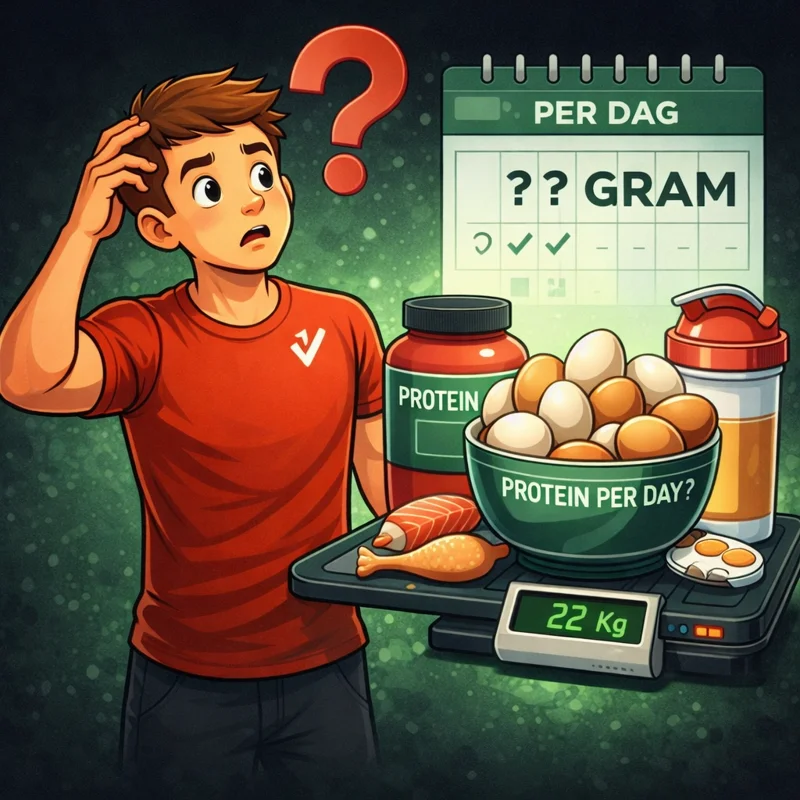
Proteins consist of amino acids, which form the building blocks for muscle tissue. When you train, micro-tears occur in your muscles. Protein provides your body with the materials needed to repair this damage and rebuild the muscles stronger. Without adequate protein, your body cannot optimally recover and grow.
Why protein is important
Proteins consist of amino acids, which form the building blocks for muscle tissue. When you train, micro-tears occur in your muscles. Protein provides your body with the materials needed to repair this damage and rebuild the muscles stronger. Without adequate protein, your body cannot optimally recover and grow.
Recommended amount per kg body weight
Research shows that for muscle building and strength training:• Minimum: 1.6g per kg body weight• Optimal: 1.6-2.2g per kg body weight• Top athletes: Up to 2.2-2.7g per kg may be beneficialFor someone of 80kg, this means 128-176g of protein per day.
- Minimum: 1.6g per kg lichaamsgewicht
- Optimaal: 1.6-2.2g per kg lichaamsgewicht
- Topatleten: Tot 2.2-2.7g per kg mogelijk voordelig
For someone weighing 80 kg, this equals 128–176 g of protein per day.
Maintenance versus muscle building
In a calorie surplus (bulking), your muscles are better protected and your body can build more efficiently. Here the lower range (1.6-1.8g/kg) is often sufficient. In a calorie deficit (cutting), the risk of muscle loss is greater. A higher protein intake (2.0-2.4g/kg) helps prevent muscle loss while you lose fat.
Practical examples
Dagmenu met ~143g eiwit:
- Ontbijt: 3 eieren (18g) + kwark (20g) = 38g
- Lunch: Kipfilet 150g (35g) + rijst + groenten
- Tussendoortje: Shake (25g)
- Diner: Rundergehakt 150g (30g) + aardappelen + groenten
- Avond: Cottage cheese (15g)
Animal and plant sources
Animal protein (meat, fish, eggs, dairy) contains all essential amino acids in the right ratio and usually has a higher biological value. Plant protein (beans, lentils, tofu, nuts) can also provide sufficient protein, but often requires combinations (for example rice + beans) to get the complete amino acid profile. Plant proteins are often less efficiently absorbed.
Distribution throughout the day
Your body can only use a limited amount of protein per meal for muscle building (about 20-40g, depending on body size). Therefore, distribute your protein intake over 3-5 meals per day for optimal muscle protein synthesis.
Timing tip
Eat a protein-rich meal around your workout, before or after, to support recovery. This does not have to happen within a 30-minute “anabolic window”, but aim to consume enough protein within roughly 2–3 hours of training.
Related articles
Want to learn more about nutrition and macros?
Discover more nutrition articlesSources and evidence
Morton et al. – protein and muscle growth; ISSN position stand – sports nutrition and protein; Meta-analyses on protein needs for strength training; Scientific studies on protein distribution throughout the day.