Recently, I have increasingly encountered people around me who say they are overstrained or who are described by others as becoming overstrained. That made me think. What does it actually mean when someone is overstrained? Where does it come from? And when do ordinary tension, fatigue or dissatisfaction develop into a situation in which someone genuinely loses their grip and can no longer function normally?
Overstrain is not simply the same as a busy week, being tired after heavy exertion or no longer feeling motivated at work. In the Dutch medical guideline, overstrain is characterized by several stress symptoms, a loss of control and clear limitations in occupational or social functioning (Nederlands Huisartsen Genootschap [NHG], 2025; Verschuren et al., 2011).
Possible symptoms include fatigue, restless sleep, irritability, reduced tolerance of noise or crowds, emotional instability, rumination, feeling rushed and concentration or memory problems. The symptoms alone are not sufficient: it is particularly the inability to handle the burden and becoming stuck in important daily roles that distinguish overstrain from ordinary tension (NHG, 2025; Verschuren et al., 2011).
Work can be an important source of strain, but overstrain does not have to arise exclusively from work. High job demands, an unfavorable effort-reward balance, low organizational justice, unclear responsibilities, private-life problems and insufficient recovery can reinforce one another (Harvey et al., 2017; Van der Molen et al., 2020; Verschuren et al., 2011).
This raises important questions. Can you truly see as a colleague that someone is overstrained? How do you distinguish overstrain from ordinary fatigue, depression, loss of motivation or job dissatisfaction? What is the difference from burnout? And how long does recovery take?
In this article, we examine what overstrain means according to medical guidelines and scientific research, which factors may contribute, how professionals assess it and what is known about recovery and return to work. We also consider how colleagues and managers can respond in a humane but careful way.
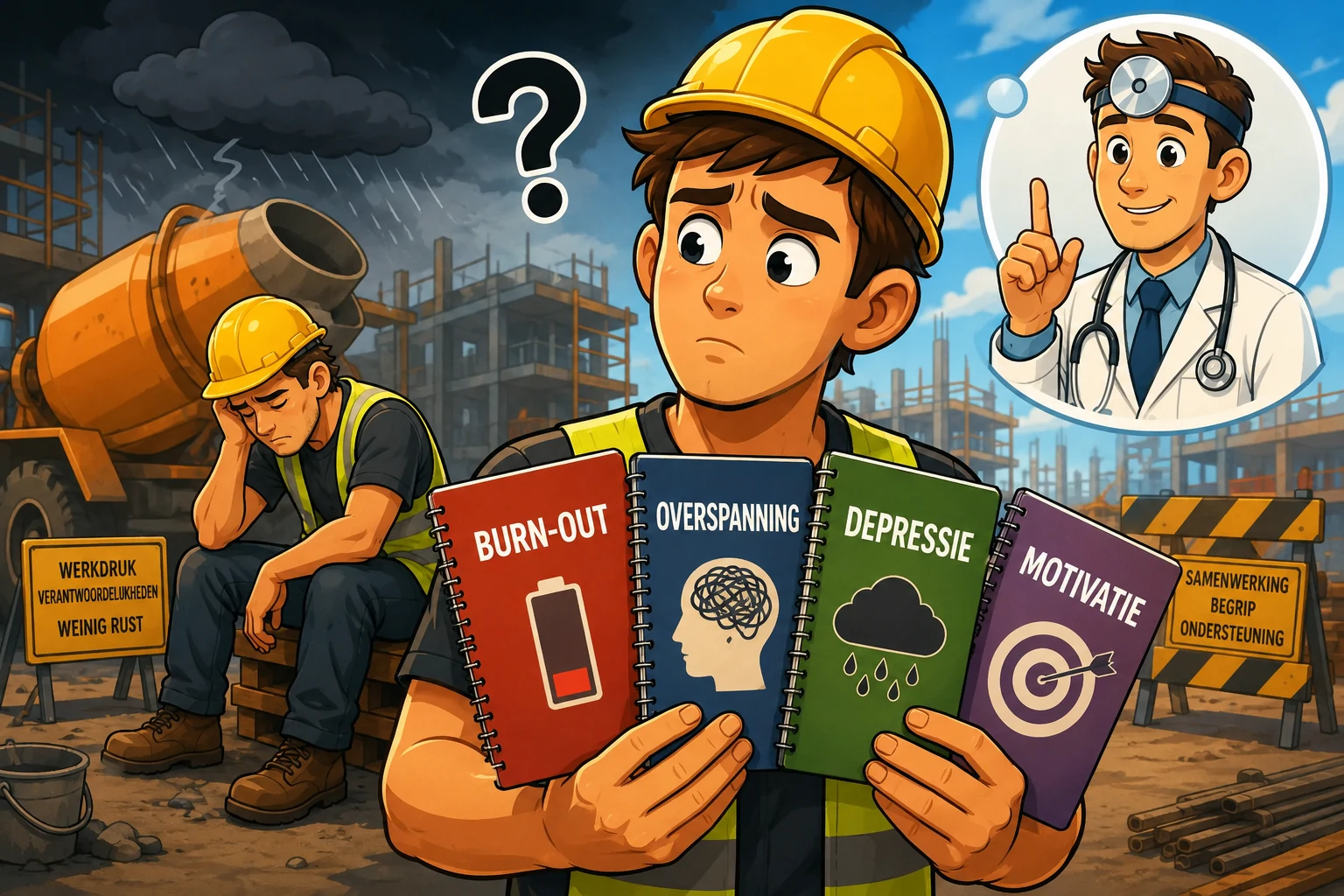
Table of contents
- In brief
- Stress is not automatically overstrain
- When do professionals speak of overstrain?
- Which symptoms and signs are involved?
- What can cause overstrain?
- Can you recognize overstrain in a colleague?
- Overstrain or job dissatisfaction?
- Overstrain, depression or anxiety?
- What is the difference from burnout?
- How long does recovery take?
- What supports recovery?
- What can colleagues and managers do?
In brief
Overstrain is a Dutch clinical term for a state in which multiple stress symptoms occur together with loss of control and clearly reduced functioning; fatigue, irritation or job dissatisfaction alone are not sufficient (NHG, 2025; Verschuren et al., 2011).
The cause usually cannot be reduced to a single event. Work factors, private-life demands, physical or psychological vulnerability, sleep loss, previous problems and insufficient recovery can accumulate and interact (Harvey et al., 2017; Palmer et al., 2024; Van der Molen et al., 2020; Verschuren et al., 2011).
A colleague may notice changes in behavior or functioning, but cannot reliably conclude from them that someone is overstrained. The same signs can occur with depression, anxiety, sleep disorders, physical illness, grief, substance-related problems or other stress-related complaints (Koutsimani et al., 2019; NHG, 2025; Terluin et al., 2006).
Within the Dutch guideline, burnout is a more prolonged presentation in which the criteria for overstrain are met, the symptoms began more than six months earlier and exhaustion is particularly prominent (NHG, 2025; Verschuren et al., 2011).
There is no fixed recovery period. Some people partially resume activities within weeks, while full recovery or sustainable return to work may take months; in more severe stress-related exhaustion conditions, residual symptoms may persist much longer (Brämberg et al., 2024; Glise et al., 2020; Nieuwenhuijsen et al., 2003; Verschuren et al., 2011).
An active, gradual approach that addresses stressors, recovery, functioning and, where necessary, the work situation is more consistent with guidelines and research than simply waiting until every symptom has disappeared (Brämberg et al., 2024; Cowansage et al., 2025; Verschuren et al., 2011).
Stress is not automatically overstrain
Stress is first and foremost an adaptive response to a challenge or threat. A short-term stress response can support alertness and action, after which the body and attention move back toward baseline when adequate recovery is available (Epel et al., 2018; McEwen & Akil, 2020).
A demanding working day, a difficult conversation, a deadline or a hard training session can therefore temporarily cause tension, fatigue or an elevated heart rate without constituting a disorder. The distinction is not based only on the intensity of one moment, but particularly on duration, opportunities for recovery, perceived control and consequences for daily functioning (Epel et al., 2018; Verschuren et al., 2011).
Prolonged, repeated or uncontrollable demands can lead to an increasing physiological and psychological burden. In stress research, this is described in part through allostasis: the body continually adapts to circumstances, but prolonged or insufficiently recovered adaptation may eventually impose costs on several systems (Epel et al., 2018; Goldstein, 2021).
Even prolonged stress is not automatically the same as overstrain. The Dutch diagnosis requires a specific combination of symptoms, loss of control and impaired functioning, which means that one person with substantial stress may continue to function while another becomes stuck under comparable stressors (NHG, 2025; Verschuren et al., 2011).
The term overstrain does not have a completely identical international equivalent. It overlaps with the international concept of adjustment disorder, in which emotional or behavioral symptoms arise in response to identifiable stressors and cause significant distress or impairment, but the precise classification and criteria differ between systems (O’Donnell et al., 2019; Verschuren et al., 2011).
When do professionals speak of overstrain?
According to the Dutch guideline, four conditions must be met before overstrain is diagnosed. First, at least three stress symptoms from the guideline list are present; second, the person experiences loss of control or helplessness because their usual ways of coping with the burden are no longer sufficient; third, there are clear limitations in occupational or social functioning; and fourth, the distress, loss of control and impaired functioning are not exclusively a direct consequence of another psychiatric disorder (NHG, 2025; Verschuren et al., 2011).
This definition shows why one isolated complaint says little. Someone can sleep poorly without being overstrained, feel irritated by a conflict without losing control or be temporarily less motivated while functioning remains largely intact (NHG, 2025; Verschuren et al., 2011).
The criterion of loss of control does not mean that someone literally has no control over anything. It refers to the experience that available problem-solving strategies no longer work adequately and that daily demands can no longer be managed in the usual way (Verschuren et al., 2011).
The criterion of impaired functioning means that symptoms have noticeable consequences for important roles. This may become visible in work, study, household tasks, caring for others or social contact, although the precise form differs between people and situations (NHG, 2025; Verschuren et al., 2011).
In Dutch primary care, the Four-Dimensional Symptom Questionnaire may be used to help distinguish general distress, depression, anxiety and somatization. The questionnaire can support assessment, but it does not replace a clinical interview, medical evaluation or differential diagnosis (Terluin et al., 2006; Verschuren et al., 2011).
Which symptoms and signs are involved?
The Dutch criteria list fatigue, disturbed or restless sleep, irritability, reduced tolerance of noise or crowds, emotional instability, rumination, feeling rushed and concentration or memory problems as possible stress symptoms (NHG, 2025; Verschuren et al., 2011).
People do not need to have every symptom, and the same symptom can occur in different conditions. Fatigue, for example, may be related to sleep loss, depression, infection, thyroid problems, medication, anemia or other physical and psychological causes, which is why medical assessment may sometimes be needed (NHG, 2025; Terluin et al., 2006).
Sleep loss can itself intensify negative emotions, irritability and difficulties with emotional regulation. It may therefore be both part of the symptom pattern and a factor that further reduces capacity (Palmer et al., 2024).
Concentration problems and forgetfulness are also nonspecific. They can occur with stress, depression, anxiety, insufficient sleep and various physical conditions, so one visible mistake or a period of poorer focus is not evidence of overstrain (Koutsimani et al., 2019; Palmer et al., 2024; Terluin et al., 2006).
A practical distinction is that ordinary fatigue is usually proportional to the exertion and clearly decreases after appropriate rest, whereas overstrain involves several simultaneous symptoms and limitations and the usual recovery and problem-solving capacity proves insufficient (NHG, 2025; Verschuren et al., 2011).
Signs that may deserve attention
Changes such as making more mistakes, difficulty maintaining an overview, stronger emotional reactions, withdrawal, more frequent absence or visible difficulty with tasks can be a reason to ask respectfully how someone is doing. These changes are observations rather than a diagnosis, because they may also arise from other work, private-life or health problems (Gayed et al., 2018; Koutsimani et al., 2019; Terluin et al., 2006).
The absence of visible signs does not rule out problems. People differ in how they express, conceal or temporarily compensate for symptoms, and functioning may remain intact in one area of life longer than in another (O’Donnell et al., 2019; Verschuren et al., 2011).
What can cause overstrain?
Overstrain generally does not arise from one universal cause, but from an interaction between demands, meaning, available resources, coping, health and recovery. The Dutch guideline therefore considers not only symptoms, but also work and private stressors, problem-solving capacity, support and circumstances that hinder or support recovery (Verschuren et al., 2011).
Work-related factors
A systematic meta-review concluded that high job demands, low decision latitude, low social support, role stress, bullying, job insecurity and an unfavorable effort-reward balance are associated to varying degrees with common mental health problems; the quality and strength of evidence differ between factors (Harvey et al., 2017).
A later systematic review and meta-analysis found elevated risks for stress-related mental disorders particularly in relation to high job demands, an unfavorable effort-reward balance and low organizational justice (Van der Molen et al., 2020).
Organizational justice includes the perceived fairness of decisions, procedures and treatment within an organization. An employee may therefore become burdened not only by the quantity of work, but also by unclear decision-making, unequal expectations or the feeling that effort and appreciation are out of balance (Van der Molen et al., 2020).
Research on depressive symptoms and burnout-like exhaustion likewise shows that high demands, low control, limited support, job insecurity and an unfavorable psychosocial work environment can be relevant risk factors, although observational associations do not prove that one factor causes the condition in every individual (Aronsson et al., 2017; Theorell et al., 2015).
A lack of management may become burdensome when priorities, roles, boundaries and responsibilities remain unclear. Scientific evidence mainly supports the broader importance of role clarity, support, fairness and manageable demands; it cannot predict that every poorly supervised employee will become overstrained (Harvey et al., 2017; Van der Molen et al., 2020).
Private-life circumstances and accumulation
Stress-related symptoms may also arise from relationship problems, loss, illness, caregiving, financial concerns, conflict or several simultaneous changes. Assessment of overstrain therefore examines the total context rather than the workplace alone (O’Donnell et al., 2019; Verschuren et al., 2011).
An individual event does not have to be extreme when several demands accumulate or persist. The risk of becoming stuck is influenced in part by perceived controllability, available support, prior vulnerability and opportunities to solve the problems in practice (Epel et al., 2018; O’Donnell et al., 2019; Verschuren et al., 2011).
Sleep and recovery
Experimental research shows that sleep loss can adversely affect mood and emotional regulation. Sleep deprivation is therefore not a standalone explanation for all overstrain, but it may intensify existing demands and put daily functioning under further pressure (Palmer et al., 2024).
Regular movement, sufficient sleep and a nutritious diet may support general physical and mental health, but they do not remove a workplace conflict, bereavement or structural overload and are not guaranteed prevention or treatment for overstrain (Firth et al., 2019; Palmer et al., 2024; Singh et al., 2023; Verschuren et al., 2011).
Read more about that broader foundation in Can resistance training make you more resilient to strain at work?, What is a healthy lifestyle?, the article on sleep and recovery and the articles in Nutrition.
Can you recognize overstrain in a colleague?
As a colleague, you may notice changes, but you see only part of someone's functioning and circumstances. You usually do not know how they sleep, what is happening privately, which physical symptoms are present or how much effort it takes to maintain their visible functioning (O’Donnell et al., 2019; Verschuren et al., 2011).
Signs such as irritability, withdrawal, lower productivity, fatigue or absence may fit overstrain, but are not specific enough to establish the diagnosis. The same signs can occur with depression, anxiety, grief, sleep loss, physical illness, substance use, a workplace conflict or ordinary dissatisfaction (Koutsimani et al., 2019; Palmer et al., 2024; Terluin et al., 2006).
An apparently contradictory situation proves little as well. Someone may be unable to work yet still perform an activity at home, or may appear calm during a conversation while daily functioning is severely reduced; functioning is context-dependent and symptoms may fluctuate (O’Donnell et al., 2019; Verschuren et al., 2011).
The question “Is this person lying or truly overstrained?” is therefore not one that a colleague can answer reliably. A health professional evaluates the pattern of symptoms, duration, loss of control, limitations, physical explanations and possible other psychological disorders (NHG, 2025; Terluin et al., 2006; Verschuren et al., 2011).
What a colleague can do is describe a concrete change without diagnosing: “I have noticed that you have been quieter lately and seem to be losing the overview more often. How are you doing?” An open, nonjudgmental approach is consistent with research in which workplace social support is associated with more favorable work and health outcomes (Etuknwa et al., 2019; Mathieu et al., 2019).
Overstrain or job dissatisfaction?
Job dissatisfaction means that someone evaluates their work, circumstances, management, pay, tasks or development opportunities negatively. Meta-analytic research shows that job satisfaction is associated with psychological health, but an association does not turn dissatisfaction into a medical diagnosis (Faragher et al., 2005).
Someone may be highly dissatisfied or unmotivated while still retaining overview, making decisions and functioning normally outside work. That does not automatically meet the criteria for overstrain, because loss of control and clear functional limitations are necessary parts of the diagnosis (NHG, 2025; Verschuren et al., 2011).
Job dissatisfaction may be concentrated mainly around work: a person no longer sees meaning in the role, wants another job, feels insufficiently valued or has a conflict with the organization. In overstrain, the focus is not merely on how the work is valued, but on a broader pattern of stress symptoms, becoming stuck and reduced functioning (Faragher et al., 2005; Verschuren et al., 2011).
The two may coexist and influence each other. Prolonged dissatisfaction, conflict, low fairness or a persistent mismatch between demands and resources may contribute to psychological strain, while someone who is already overstrained or depressed may also begin to experience work more negatively (Faragher et al., 2005; Harvey et al., 2017; Van der Molen et al., 2020).
Reduced motivation may also be a consequence of exhaustion, depressive symptoms, lack of autonomy, little appreciation or a deliberate conclusion that the role no longer fits. Loss of motivation alone therefore does not reveal the underlying cause (Faragher et al., 2005; Koutsimani et al., 2019; Theorell et al., 2015).
A practical distinction
When job dissatisfaction is the main issue, negative feelings may be strongly tied to the specific role or organization, while control and functioning in other areas remain relatively intact. In overstrain, the guideline requires multiple symptoms, insufficient control and clear impaired functioning, but only a professional assessment can determine how this should be interpreted for one person (NHG, 2025; Verschuren et al., 2011).
Overstrain, depression or anxiety?
Overstrain, depression and anxiety may share symptoms including fatigue, sleep problems, concentration difficulties, restlessness and reduced functioning. Because of this overlap, an assessment based on one symptom or brief observation is unreliable (Koutsimani et al., 2019; Terluin et al., 2006).
In a depressive disorder, a persistent low mood and/or a clear loss of interest or pleasure are central, together with other symptoms and limitations. In the Dutch definition of overstrain, the central pattern is becoming stuck under stressors, loss of control and the associated distress and functional limitations (NHG, 2025; Terluin et al., 2006; Verschuren et al., 2011).
Anxiety disorders are characterized by specific patterns of excessive fear, worry, avoidance or panic, depending on the type of disorder. Rumination and feeling rushed may also occur in overstrain, so the content, duration, triggers and consequences of the anxiety must be examined (NHG, 2025; Terluin et al., 2006).
The international diagnosis of adjustment disorder overlaps with overstrain because symptoms are linked to identifiable stressors and cause distress or impairment. At the same time, criteria differ and international debate continues about the boundaries, measurement and treatment of adjustment disorder (O’Donnell et al., 2019).
The presence of stressors does not exclude another disorder. Someone may, for example, have both depression and serious work problems, or develop anxiety during a period of high demands; the guideline therefore requires differential diagnosis rather than a simple choice based on the work context (NHG, 2025; Terluin et al., 2006; Verschuren et al., 2011).
Do not overlook physical explanations
Fatigue, sleep problems, cognitive symptoms and feeling rushed may also be related to physical illness, medication or substance use. Depending on symptoms, duration and medical history, a general practitioner can assess whether additional physical examination is needed (NHG, 2025; Verschuren et al., 2011).
What is the difference from burnout?
In everyday language, stress, overstrain and burnout are often used interchangeably. Scientific and clinical definitions of burnout also vary, which means that study findings are not always directly comparable (Koutsimani et al., 2019; Verschuren et al., 2011).
Within the Dutch primary-care guideline, burnout is a more prolonged form of overstrain. The criteria for overstrain must be met, symptoms began more than six months earlier and feelings of fatigue and exhaustion are particularly prominent (NHG, 2025; Verschuren et al., 2011).
In international occupational-psychology literature, burnout is often described through exhaustion, mental distance or cynicism toward work and reduced professional efficacy. That concept is not completely identical to the Dutch medical criteria and is not treated everywhere internationally as a separate mental disorder (Aronsson et al., 2017; Koutsimani et al., 2019).
Burnout and depression are strongly related, but a systematic review and meta-analysis found insufficient grounds to regard them as exactly the same construct. The overlap is substantial enough that depression and anxiety should also be carefully assessed when symptoms are severe or broad (Koutsimani et al., 2019).
The practical conclusion is that being tired for a long time does not by itself prove burnout. Duration, symptom pattern, relationship with stressors, degree of exhaustion, loss of control, functioning and possible alternative explanations must be evaluated together (NHG, 2025; Koutsimani et al., 2019; Verschuren et al., 2011).
How long does recovery take?
There is no fixed recovery period that applies to everyone. The course is related to factors including the severity and duration of symptoms, coexisting psychological or physical problems, ongoing stressors, support, working conditions and opportunities to resume activities gradually (Fisker et al., 2022; Verschuren et al., 2011).
The Dutch guideline describes recovery as a process involving roughly three tasks: first, becoming calmer, understanding what is happening and regaining some control; second, identifying problems and possible solutions; and third, applying solutions and gradually resuming roles. These phases are not a rigid timetable and may overlap (Verschuren et al., 2011).
In a Dutch retrospective cohort of employees with adjustment disorders, the median time to full recovery was 195 days and 73% had fully recovered after one year. These figures come from older occupational-health care and should not be used as a personal prediction or current norm (Nieuwenhuijsen et al., 2003).
A systematic review of return to work among people with common mental disorders found that prognosis is related to various personal, illness-related and work factors. The heterogeneity between studies underlines that an average says little about the exact duration for one individual (Fisker et al., 2022).
Research on Swedish exhaustion disorder shows persistent residual symptoms in some patients even years after treatment. This is a more severe and differently defined stress-related condition than Dutch overstrain, so these findings mainly show that severe exhaustion conditions can sometimes be long-lasting and should not be applied directly to every overstrained employee (Glise et al., 2020).
Returning to work and being completely symptom-free are not the same thing. An employee may responsibly resume work partially while symptoms remain, and someone may have fewer symptoms but still feel uncertain about work; sustainable return therefore requires attention to both recovery and the work situation (Brämberg et al., 2024; Etuknwa et al., 2019).
Can someone recover after one or two weeks?
A short period of rest may be sufficient for ordinary temporary overload, but when someone genuinely meets the guideline criteria for overstrain, full and sustainable recovery within a few days is not self-evident. At the same time, a long period of absence is not proof that someone is more seriously ill, because recovery and return are also influenced by working conditions, care, expectations and private-life demands (Fisker et al., 2022; Nieuwenhuijsen et al., 2003; Verschuren et al., 2011).
Can recovery take years?
Symptoms can persist for years in severe or prolonged stress-related exhaustion, but such studies often concern selected patients with a more serious presentation than the average person with overstrain. It is therefore more accurate to say that recovery may range from weeks to many months and, in some severe conditions, longer, without predicting a fixed period in advance (Glise et al., 2020; Verschuren et al., 2011).
What supports recovery?
Recovery is not based on one miracle solution, but on reducing or making relevant stressors manageable, regaining control, restoring daily structure and gradually resuming activities and roles (Verschuren et al., 2011).
1. Understanding what is happening
Psychoeducation can help make symptoms, stressors and recovery responses understandable. In the Dutch guideline, normalizing stress responses without minimizing the limitations is part of the first phase (Verschuren et al., 2011).
2. Recovery and problem solving
Rest alone does not change an ongoing workplace conflict, unclear task allocation, caregiving burden or financial concern. The guideline therefore emphasizes not only recovery, but also identifying problems, choosing feasible solutions and increasing control (Verschuren et al., 2011).
3. Daily structure and gradual activity
A recognizable daily rhythm, alternation between activity and recovery and gradual resumption may prevent someone from remaining completely passive or, conversely, resuming every obligation too quickly. The exact progression should match symptoms, abilities and professional advice (Brämberg et al., 2024; Verschuren et al., 2011).
4. Appropriate psychological treatment
Treatment research for adjustment disorder is more limited than for depression and anxiety. A recent systematic review of randomized trials suggests that both online and face-to-face cognitive behavioral therapy may reduce symptoms, but the number of available studies remains limited and findings should be interpreted cautiously (Cowansage et al., 2025).
5. Work-focused support
A 2024 systematic review found low-certainty evidence that work-focused cognitive behavioral therapy and team-based support may speed return to work compared with usual care or no intervention. Low certainty means that future research may change the estimate (Brämberg et al., 2024).
Work-focused support may include discussing barriers, adjusting tasks or hours, maintaining contact between the employee and workplace and using a gradual progression. Appropriate adjustments depend on the person, role and assessment by professionals including the occupational physician (Brämberg et al., 2024; Etuknwa et al., 2019).
6. Sleep, movement and nutrition as a supportive foundation
Sleep loss can worsen negative emotion and emotional regulation, while physical activity has beneficial average effects on depression, anxiety and psychological distress. Dietary interventions show small average benefits for depressive symptoms, but these lifestyle factors are not a substitute for addressing stressors or receiving appropriate treatment (Firth et al., 2019; Palmer et al., 2024; Singh et al., 2023).
Someone who is severely exhausted does not need to begin training hard immediately. Activity should fit the person's capacity, medical situation and overall recovery plan; greater exertion is not automatically better when it causes further deterioration (Singh et al., 2023; Verschuren et al., 2011).
For more detail, read Can resistance training make you more resilient to strain at work?, What is a healthy lifestyle?, Why sleep matters for muscle growth and recovery and the articles in Nutrition.
What can colleagues and managers do?
As a colleague
A colleague does not need to diagnose or become a therapist. Listening, describing a change, showing interest and not immediately labeling someone as lazy, weak or dishonest are more appropriate responses than drawing your own conclusions about the cause (Etuknwa et al., 2019; Mathieu et al., 2019).
A useful opening is concrete and nondiagnostic: “I have noticed that you have been quieter lately and seem to be struggling with the overview. How are you doing?” This describes what you observe without saying that someone is overstrained, depressed or unfit for work (Gayed et al., 2018).
Respect does not mean that you must structurally take over all tasks or problems. Clear boundaries and fair task distribution remain important for both the employee concerned and the rest of the team (Harvey et al., 2017; Van der Molen et al., 2020).
When someone shares personal information, discretion about passing it on is appropriate. If there are immediate concerns about safety or serious disorganization, it may be necessary to involve a manager or qualified professional, following the organization's procedures (Gayed et al., 2018).
As a manager
Managers cannot make a medical diagnosis, but they influence clarity, workload, support, fairness and opportunities for adjustment. These psychosocial work factors are associated with stress-related mental problems and exhaustion (Aronsson et al., 2017; Harvey et al., 2017; Van der Molen et al., 2020).
A systematic review and meta-analysis showed that manager training can improve knowledge, attitudes and self-reported supportive behavior relating to employee mental health. Evidence that such training directly reduces employee symptoms was still limited in that review (Gayed et al., 2018).
A manager can ask what someone needs in order to function safely and feasibly, clarify unclear priorities, discuss temporary adjustments and direct the employee to an occupational physician. The occupational physician assesses the relationship between health and work and can advise on capacity and work resumption (Brämberg et al., 2024; Verschuren et al., 2011).
Simply telling someone to “take some rest” may be insufficient if the source at work remains unchanged. Sustainable return is more likely when work factors, support, expectations and possible adjustments are also considered (Brämberg et al., 2024; Etuknwa et al., 2019).
My personal reflection
This section describes my own experience and perspective. It is not a scientific conclusion and does not have to be the same for everyone.
As far as I can judge, I have never personally experienced a period of overstrain. I have naturally had times when I was very tired. This happened, for example, after a demanding working day, an intense training session, too little sleep or a period in which I was doing many things at once. But it was usually fatigue that I could explain and from which I recovered after rest or a good night's sleep.
Sometimes I still had muscle soreness the next day or could feel that my body had been heavily loaded. Even so, I remained able to do my daily activities. I could continue thinking, doing my job, training, making plans and keeping an overview of my responsibilities. I have never experienced being completely exhausted for weeks, continuously being in a poor mood or feeling that I had lost control over my life and obligations.
I think that distinction matters. Being tired does not automatically mean someone is overstrained. A heavy body after exertion is not the same as being unable to recover for a prolonged period. One day without motivation or being irritated at work also does not immediately mean there is a psychological problem.
Precisely because I have not experienced overstrain from the inside, I want to be careful in judging others. I do not know exactly what someone feels, which problems exist at home, how they sleep or how much strain they have been trying to absorb for a long time. What is still manageable for one person may be too much for another at that moment.
I do think you can sometimes see as a colleague that someone changes. A person may become quieter, react more irritably, withdraw or visibly struggle with tasks that previously came naturally. But that does not mean I can determine the cause. I am not a doctor, psychologist or occupational physician.
My role as a colleague is therefore not to determine whether someone is “really” overstrained. I can ask respectfully how things are going, listen without immediately judging and show understanding when someone is clearly struggling. At the same time, I do not have to take over all of that person's problems. There is a difference between showing compassion and making yourself responsible for someone else's recovery.
What personally helps me process strain and fatigue is a combination of structure, resistance training, movement, conscious eating, sufficient rest and protecting my own boundaries. That is my experience and not a guarantee for someone else. This article is therefore not intended to present my way of living as a universal solution, but to better understand why some people eventually lose their grip and what may then be needed for recovery.
Short self-reflection
These questions are intended to help you consider your own situation and are not a validated test or diagnosis.
- Do you usually recover clearly after a free evening, a good night's sleep or a quiet weekend?
- Have you experienced several symptoms for multiple weeks, such as poor sleep, irritation, rumination, fatigue or concentration problems?
- Do you still feel able to understand and address the most important problems?
- Can you still perform your normal roles at work, at home and socially?
- Are your symptoms mainly tied to one unpleasant work situation, or do you notice limitations in several areas of life?
- Which work or private-life factors continue to maintain the burden?
- Which responsibility are you carrying that does not in fact belong to you alone?
- Which professional or trusted person could you discuss the situation with?
The combination of several stress symptoms, loss of control and reduced functioning is a reason not to rely only on self-help and to consult a general practitioner or occupational physician (NHG, 2025; Verschuren et al., 2011).
When professional support is advisable
Contact a general practitioner when symptoms persist, increase, limit daily functioning or when there is uncertainty about physical or psychological causes. An occupational physician is the appropriate professional for questions about capacity, sickness absence, workplace adjustments and responsible return to work (NHG, 2025; Verschuren et al., 2011).
Prompt professional assessment is especially important in the presence of severe low mood, thoughts of self-harm or suicide, severe anxiety or panic, confusion, substance-related problems, complete loss of functioning or physical warning signs. These signs may indicate a more serious or different problem than overstrain and require appropriate medical assessment (NHG, 2025; Terluin et al., 2006).
An online article can help explain concepts, but it cannot diagnose, exclude physical causes or create a personal treatment or reintegration plan (NHG, 2025; Verschuren et al., 2011).
Conclusion
Overstrain is more than fatigue, work stress or temporarily lacking motivation. According to the Dutch guideline, it involves several stress symptoms combined with loss of control and clearly reduced functioning (NHG, 2025; Verschuren et al., 2011).
Work may contribute substantially, particularly when high demands, limited support, ambiguity, low fairness or a poor effort-reward balance persist. Private-life demands, sleep loss, health and recovery opportunities are also part of the overall picture (Harvey et al., 2017; Palmer et al., 2024; Van der Molen et al., 2020).
A colleague may notice changes and show compassion, but cannot reliably determine whether someone is truly overstrained or has another condition. Asking respectfully, listening, maintaining boundaries and encouraging professional support when needed are more careful than diagnosing or distrusting the person (Etuknwa et al., 2019; Gayed et al., 2018; Terluin et al., 2006).
Recovery does not follow one calendar. It generally requires an active and gradual combination of recovery, regaining control, problem solving, appropriate care and, where needed, workplace adjustments (Brämberg et al., 2024; Cowansage et al., 2025; Verschuren et al., 2011).
As a colleague, you do not have to determine what someone has. You can respond humanely, listen carefully and recognize that visible behavior never tells the entire story.
Read next
Scientific sources
- Aronsson, G., Theorell, T., Grape, T., Hammarström, A., Hogstedt, C., Marteinsdottir, I., Skoog, I., Träskman-Bendz, L., & Hall, C. (2017). A systematic review including meta-analysis of work environment and burnout symptoms. BMC Public Health, 17, Article 264. Open source
- Brämberg, E. B., Åhsberg, E., Fahlström, G., Furberg, E., Gornitzki, C., Ringborg, A., & Skogman Thoursie, P. (2024). Effects of work-directed interventions on return-to-work in people on sick-leave for common mental disorders: A systematic review. International Archives of Occupational and Environmental Health, 97(6), 597–619. Open source
- Cowansage, K. P., Milligan, T., Morgan, M. A., Boyd, C., Bellanti, D. M., Nair, R., Shank, L. M., Smolenski, D., Evatt, D. P., & Kelber, M. S. (2025). Treatments for adjustment disorder: A systematic review and meta-analysis of randomized controlled trials. Psychiatry Research, 353, Article 116739. Open source
- Epel, E. S., Crosswell, A. D., Mayer, S. E., Prather, A. A., Slavich, G. M., Puterman, E., & Mendes, W. B. (2018). More than a feeling: A unified view of stress measurement for population science. Frontiers in Neuroendocrinology, 49, 146–169. Open source
- Etuknwa, A., Daniels, K., & Eib, C. (2019). Sustainable return to work: A systematic review focusing on personal and social factors. Journal of Occupational Rehabilitation, 29(4), 679–700. Open source
- Faragher, E. B., Cass, M., & Cooper, C. L. (2005). The relationship between job satisfaction and health: A meta-analysis. Occupational and Environmental Medicine, 62(2), 105–112. Open source
- Firth, J., Marx, W., Dash, S., Carney, R., Teasdale, S. B., Solmi, M., Stubbs, B., Schuch, F. B., Carvalho, A. F., Jacka, F., & Sarris, J. (2019). The effects of dietary improvement on symptoms of depression and anxiety: A meta-analysis of randomized controlled trials. Psychosomatic Medicine, 81(3), 265–280. Open source
- Fisker, J., Hjorthøj, C., Hellström, L., Mundy, S. S., Rosenberg, N. G., & Eplov, L. F. (2022). Predictors of return to work for people on sick leave with common mental disorders: A systematic review and meta-analysis. International Archives of Occupational and Environmental Health, 95(7), 1429–1441. Open source
- Gayed, A., Milligan-Saville, J. S., Nicholas, J., Bryan, B. T., LaMontagne, A. D., Milner, A., Madan, I., Calvo, R. A., Christensen, H., Mykletun, A., Glozier, N., & Harvey, S. B. (2018). Effectiveness of training workplace managers to understand and support the mental health needs of employees: A systematic review and meta-analysis. Occupational and Environmental Medicine, 75(6), 462–470. Open source
- Glise, K., Wiegner, L., & Jonsdottir, I. H. (2020). Long-term follow-up of residual symptoms in patients treated for stress-related exhaustion. BMC Psychology, 8, Article 26. Open source
- Goldstein, D. S. (2021). Stress and the “extended” autonomic system. Autonomic Neuroscience, 236, Article 102889. Open source
- Harvey, S. B., Modini, M., Joyce, S., Milligan-Saville, J. S., Tan, L., Mykletun, A., Bryant, R. A., Christensen, H., & Mitchell, P. B. (2017). Can work make you mentally ill? A systematic meta-review of work-related risk factors for common mental health problems. Occupational and Environmental Medicine, 74(4), 301–310. Open source
- Koutsimani, P., Montgomery, A., & Georganta, K. (2019). The relationship between burnout, depression, and anxiety: A systematic review and meta-analysis. Frontiers in Psychology, 10, Article 284. Open source
- Mathieu, M., Eschleman, K. J., & Cheng, D. (2019). Meta-analytic and multiwave comparison of emotional support and instrumental support in the workplace. Journal of Occupational Health Psychology, 24(3), 387–409. Open source
- McEwen, B. S., & Akil, H. (2020). Revisiting the stress concept: Implications for affective disorders. Journal of Neuroscience, 40(1), 12–21. Open source
- Nederlands Huisartsen Genootschap. (2025). NHG-Standaard Overspanning en burn-out. Open source
- Nieuwenhuijsen, K., Verbeek, J. H. A. M., Siemerink, J. C. M. J., & Tummers-Nijsen, D. (2003). Quality of rehabilitation among workers with adjustment disorders according to practice guidelines: A retrospective cohort study. Occupational and Environmental Medicine, 60(Suppl. 1), i21–i25. Open source
- O’Donnell, M. L., Agathos, J. A., Metcalf, O., Gibson, K., & Lau, W. (2019). Adjustment disorder: Current developments and future directions. International Journal of Environmental Research and Public Health, 16(14), Article 2537. Open source
- Palmer, C. A., Bower, J. L., Cho, K. W., Clementi, M. A., Lau, S., Oosterhoff, B., & Alfano, C. A. (2024). Sleep loss and emotion: A systematic review and meta-analysis of over fifty years of experimental research. Psychological Bulletin, 150(4), 440–463. Open source
- Singh, B., Olds, T., Curtis, R., Dumuid, D., Virgara, R., Watson, A., Szeto, K., O’Connor, E., Ferguson, T., Eglitis, E., Miatke, A., Simpson, C. E. M., & Maher, C. (2023). Effectiveness of physical activity interventions for improving depression, anxiety and distress: An overview of systematic reviews. British Journal of Sports Medicine, 57(18), 1203–1209. Open source
- Terluin, B., van Marwijk, H. W. J., Adèr, H. J., de Vet, H. C. W., Penninx, B. W. J. H., Hermens, M. L. M., van Boeijen, C. A., van Balkom, A. J. L. M., van der Klink, J. J. L., & Stalman, W. A. B. (2006). The Four-Dimensional Symptom Questionnaire (4DSQ): A validation study of a multidimensional self-report questionnaire to assess distress, depression, anxiety and somatization. BMC Psychiatry, 6, Article 34. Open source
- Theorell, T., Hammarström, A., Aronsson, G., Träskman Bendz, L., Grape, T., Hogstedt, C., Marteinsdottir, I., Skoog, I., & Hall, C. (2015). A systematic review including meta-analysis of work environment and depressive symptoms. BMC Public Health, 15, Article 738. Open source
- Van der Molen, H. F., Nieuwenhuijsen, K., Frings-Dresen, M. H. W., & de Groene, G. (2020). Work-related psychosocial risk factors for stress-related mental disorders: An updated systematic review and meta-analysis. BMJ Open, 10(7), e034849. Open source
- Verschuren, C. M., Terluin, B., Loo, M. A. J. M., Bastiaanssen, M. H. H., Vriezen, J. A., & Van der Klink, J. J. L. (2011). Eén lijn in de eerste lijn bij overspanning en burn-out: Multidisciplinaire richtlijn overspanning en burn-out voor eerstelijns professionals. LVE, NHG & NVAB. Open source