Many people start training, eating healthier or losing weight with strong motivation. Their goals are clear and the first few weeks often feel promising. But after a while, many people get stuck. They no longer remember exactly what weight they used last week, they think they eat enough protein without really checking it, or they feel they are not progressing while the data may tell a different story.
That is why tracking progress is valuable. Not because numbers create results by themselves, but because they create insight. And insight makes it easier to make better decisions.
The core idea is simple: an app does not build muscle for you and it does not burn calories for you. But a good app can help make behavior visible, track progress and show earlier where adjustments may be needed.
What is self-monitoring?
Self-monitoring means consciously keeping track of data about your own behavior or results. Within fitness and health, this can include body weight, nutrition, workouts, sets, reps, weights, recovery, energy, sleep or training volume per muscle group.
Self-monitoring is a well-known technique within behavior change. In a systematic review on weight loss, Burke et al. (2011) concluded that self-monitoring is a central component of behavioral weight-loss programs. Tracking diet, physical activity and body weight often appeared as important strategies.
This does not mean tracking automatically creates results. You still need to train, eat, recover and stay consistent. But tracking helps show what is actually happening.
Why feeling alone is often not enough
Many people judge their progress by feeling. They may say: “I eat pretty healthy,” “I train about the same as last week,” or “I think I am getting stronger.” The problem is that feeling is not always reliable.
You may think you eat little while unknowingly consuming more calories than expected. You may think you are not progressing while your weekly average body weight is decreasing. You may think you are training harder than last month while your training volume is actually lower.
When you track data, vague impressions are replaced with concrete information. Instead of “I think my bench press is improving,” you may see: “my bench press increased from 80 kg × 8 to 90 kg × 8 in twelve weeks.”
What does research say about digital tracking?
An important question is whether it matters if you track progress in an app or in a notebook. A notebook can work very well. Many successful athletes have tracked their training with pen and paper for years. The key principle is not necessarily the app itself, but consistently tracking what you do.
Still, digital tools can have advantages. Patel et al. (2021) studied digital self-monitoring in weight-loss interventions among adults with overweight or obesity. They found that greater engagement with digital self-monitoring was often associated with greater weight loss. Digital methods also showed higher engagement than paper-based monitoring in many comparisons.
That makes sense. An app is often faster, clearer and easier to update. You do not have to search through old notes, graphs are generated automatically and previous performances are easy to find.
Apps and physical activity
Research on apps for physical activity shows a similar picture: apps can help, but the effects are not magical. Schoeppe et al. (2016) found modest evidence in a systematic review that app-based interventions can improve diet, physical activity and sedentary behavior.
Romeo et al. (2019) found modest evidence in a systematic review and meta-analysis that smartphone apps can increase physical activity, especially in the shorter term. Laranjo et al. (2021) also concluded that interventions with smartphone apps or activity trackers can promote physical activity in adults.
The lesson is important: an app is most useful when it helps people sustain behavior. Think goal setting, feedback, visible progress, reminders and pattern recognition.
Progressive overload: why tracking matters in strength training
In strength training and muscle growth, progressive overload plays a major role. Progressive overload means gradually giving the body a larger training stimulus. This can happen through more weight, more reps, more sets, better technique, more total volume or better control of the same exercise.
The American College of Sports Medicine describes progression as an important principle within resistance training: to stimulate further adaptation toward a training goal, the training stimulus must be adjusted systematically (American College of Sports Medicine, 2009).
If you do not know what you did last week, progressive overload becomes guesswork. But if you see that last time you did 30 kg × 10 and now you perform 30 kg × 11 or 32 kg × 8, you gain direction. You can see whether you are improving, staying the same or regressing.
Training volume per muscle group: why detail matters
Training volume is an important variable for muscle growth. In practice, people often look at the number of effective sets per muscle group per week, sometimes combined with total volume or performance development per exercise.
Schoenfeld et al. (2017) examined the relationship between weekly training volume and muscle growth in a systematic review and meta-analysis. They found a dose-response relationship in which higher weekly training volumes were associated with greater increases in muscle mass.
This does not mean more is always better. Recovery, technique, intensity and individual tolerance still matter. But it does show why it can be valuable to monitor volume per muscle group. If chest growth is lagging, you want to know whether chest volume is stable, rising or falling.
Progress per exercise: recognizing stagnation earlier
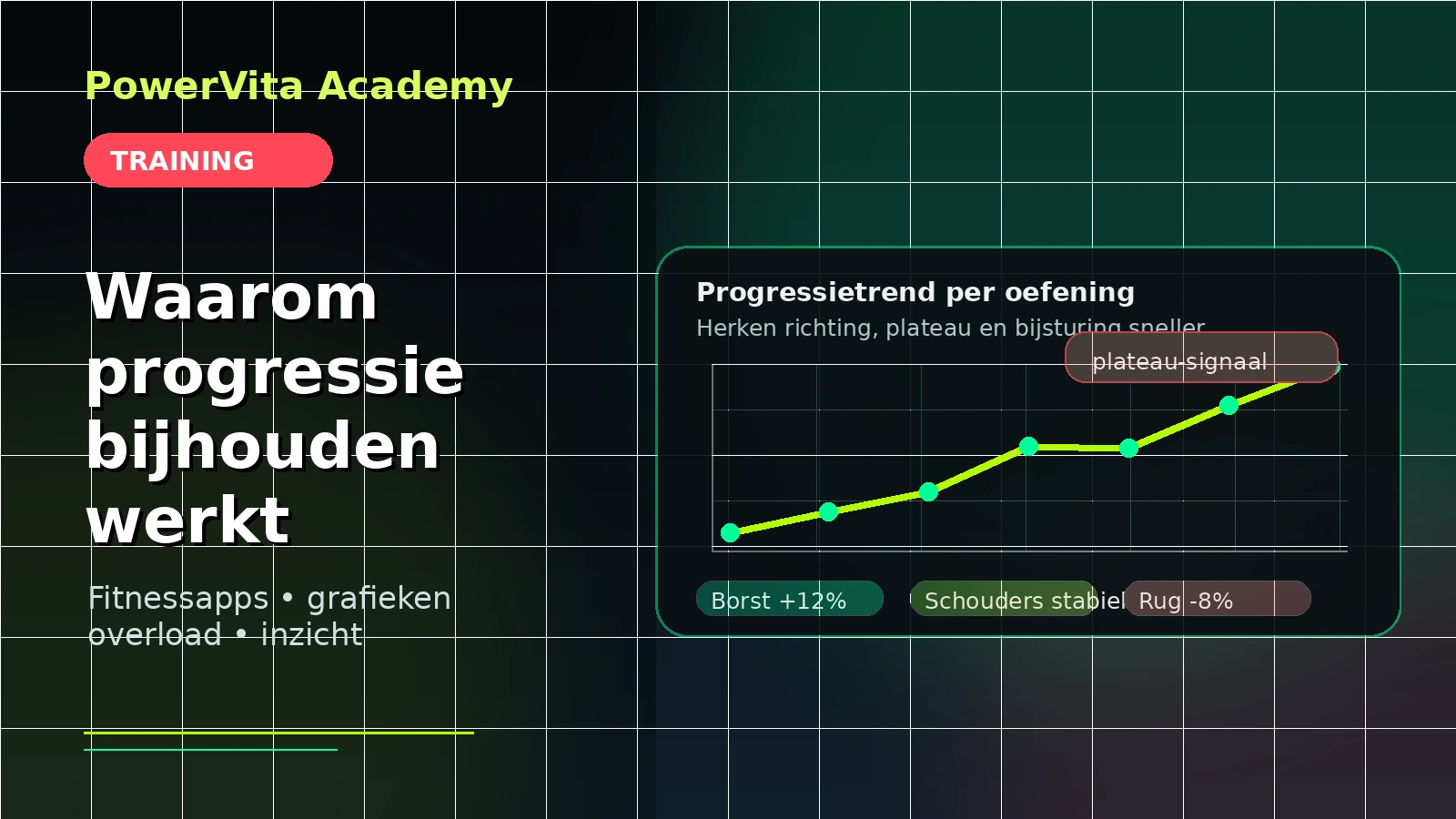
Another advantage of tracking is that stagnation can be recognized earlier. Many athletes only notice late that they are stuck. They train for weeks with roughly the same weights and reps without realizing that there is no clear progress.
When you have graphs per exercise, you can see what is happening more quickly. For the bench press, for example, you can look at whether estimated 1RM is rising, whether working weight is increasing, whether reps are improving and whether volume is stable or declining.
The point is not that every temporary stagnation is immediately a problem. The point is that without data, you notice what is happening later and therefore adjust later.
From data to feedback
Collecting data is step one. But data alone is not enough. An app can show that your chest volume was 10 sets this week, but the user still has to interpret what that means.
That is why feedback matters. Krukowski et al. (2024) examined feedback within self-monitoring interventions. They found that feedback can be an important behavior change technique, but also that effects differ by outcome and context. Physical activity interventions with feedback showed more favorable effects than interventions without feedback.
That is the difference between simply recording and truly gaining insight. Data says: “your chest volume was 10 sets.” Feedback says: “your chest volume has decreased over the last four weeks; if chest growth is your goal, this may affect your progress.”
Motivation and consistency
Tracking progress can also support motivation. Not because everyone is motivated by numbers, but because small progress becomes visible. In fitness, progress is often slow. Especially with muscle growth, you do not see a visible difference in the mirror every day.
In data, you may still see improvement: two more reps, 2.5 kg more weight, a slowly decreasing weight trend or better training consistency. These signals can support motivation when the visible result is not yet obvious.
Research on engagement with mHealth apps suggests that techniques such as goal setting, self-monitoring, feedback, reminders, rewards and social support are often linked to user engagement (Milne-Ives et al., 2023).
The limits of tracking
It is important to stay honest. An app is not a guarantee of results. You can log everything perfectly and still make little progress if your training is poor, your nutrition does not match your goal, your recovery is weak or you are not consistent enough.
Tracking should also not become obsessive. For some people, too much focus on numbers can create stress. Data should support you, not control you.
App or notebook: which is better?
The most honest conclusion is this: a notebook can work if you are consistent. An app can work better if it makes tracking easier, clearer and more valuable.
The difference is not “digital” by itself. The difference is what the app adds: automatic graphs, trends over time, quick access to previous performances, insight per exercise, insight per muscle group, data-based feedback and signals of stagnation.
A simple note can tell you what you did. A good app can help you understand what it means.
What does this mean in practice?
If you want better results, you do not have to track everything perfectly from day one. Start simple. In strength training, begin with exercise, weight, reps, sets and optionally how hard it felt. For losing or gaining weight, start with body weight, weekly averages, nutrition, protein intake and daily activity.
Over time, a pattern starts to appear. Not based on one day, but based on trends. Those trends are valuable because they show whether your approach is working over multiple weeks.
How this principle appears in modern fitness apps
The best fitness apps therefore do more than store data. They make patterns visible. Think progress per exercise, volume per muscle group, weight trends, recovery data, possible stagnation and recommendations based on the data entered.
That is also the direction we think about at PowerVita: not showing as many numbers as possible, but making the right numbers understandable. More insight, less guesswork.
Conclusion
Scientific research suggests that self-monitoring can be an important part of behavior change, weight management and physical activity. Digital tools such as apps can make tracking easier and are often sustained better than paper-based monitoring.
For muscle growth, the evidence is more indirect, but logically strong: progressive overload and training volume are important principles in resistance training. To apply those principles well, you need to know what you are doing, how your performance changes and where stagnation may appear.
An app does not build muscle for you. An app does not burn calories for you. And an app does not replace good training, nutrition or coaching. But a good app can help you train more consciously, make progress visible and make better decisions.
That can ultimately be the difference between simply training and progressing with direction.
References
- American College of Sports Medicine. (2009). American College of Sports Medicine position stand. Progression models in resistance training for healthy adults. Medicine & Science in Sports & Exercise, 41(3), 687–708. https://doi.org/10.1249/MSS.0b013e3181915670
- Burke, L. E., Wang, J., & Sevick, M. A. (2011). Self-monitoring in weight loss: A systematic review of the literature. Journal of the American Dietetic Association, 111(1), 92–102. https://doi.org/10.1016/j.jada.2010.10.008
- Krukowski, R. A., Denton, A. H., & König, L. M. (2024). Impact of feedback generation and presentation on self-monitoring behaviors, dietary intake, physical activity, and weight: A systematic review and meta-analysis. International Journal of Behavioral Nutrition and Physical Activity, 21, Article 3. https://doi.org/10.1186/s12966-023-01555-6
- Laranjo, L., Ding, D., Heleno, B., Kocaballi, B., Quiroz, J. C., Tong, H. L., Chahwan, B., Neves, A. L., Gabarron, E., Dao, K. P., Rodrigues, D., Neves, G. C., Antunes, M. L., Coiera, E., & Bates, D. W. (2021). Do smartphone applications and activity trackers increase physical activity in adults? Systematic review, meta-analysis and metaregression. British Journal of Sports Medicine, 55(8), 422–432. https://doi.org/10.1136/bjsports-2020-102892
- Madigan, C. D., Daley, A. J., Lewis, A. L., Aveyard, P., & Jolly, K. (2015). Is self-weighing an effective tool for weight loss: A systematic literature review and meta-analysis. International Journal of Behavioral Nutrition and Physical Activity, 12, Article 104. https://doi.org/10.1186/s12966-015-0267-4
- Milne-Ives, M., Lam, C., De Cock, C., Van Velthoven, M. H., & Meinert, E. (2023). Potential associations between behavior change techniques and engagement with mobile health apps: A systematic review. Frontiers in Psychology, 14, Article 1227443. https://doi.org/10.3389/fpsyg.2023.1227443
- Patel, M. L., Wakayama, L. N., & Bennett, G. G. (2021). Self-monitoring via digital health in weight loss interventions: A systematic review among adults with overweight or obesity. Obesity, 29(3), 478–499. https://doi.org/10.1002/oby.23088
- Romeo, A., Edney, S., Plotnikoff, R., Curtis, R., Ryan, J., Sanders, I., Crozier, A., & Maher, C. (2019). Can smartphone apps increase physical activity? Systematic review and meta-analysis. Journal of Medical Internet Research, 21(3), Article e12053. https://doi.org/10.2196/12053
- Schoenfeld, B. J., Ogborn, D., & Krieger, J. W. (2017). Dose-response relationship between weekly resistance training volume and increases in muscle mass: A systematic review and meta-analysis. Journal of Sports Sciences, 35(11), 1073–1082. https://doi.org/10.1080/02640414.2016.1210197
- Schoeppe, S., Alley, S., Van Lippevelde, W., Bray, N. A., Williams, S. L., Duncan, M. J., & Vandelanotte, C. (2016). Efficacy of interventions that use apps to improve diet, physical activity and sedentary behaviour: A systematic review. International Journal of Behavioral Nutrition and Physical Activity, 13, Article 127. https://doi.org/10.1186/s12966-016-0454-y
Do you want to track your progress more easily and better understand what your numbers mean? Learn more about the Vita app and discover how you can track training, nutrition and progress in one clear place.
Learn more about the Vita app