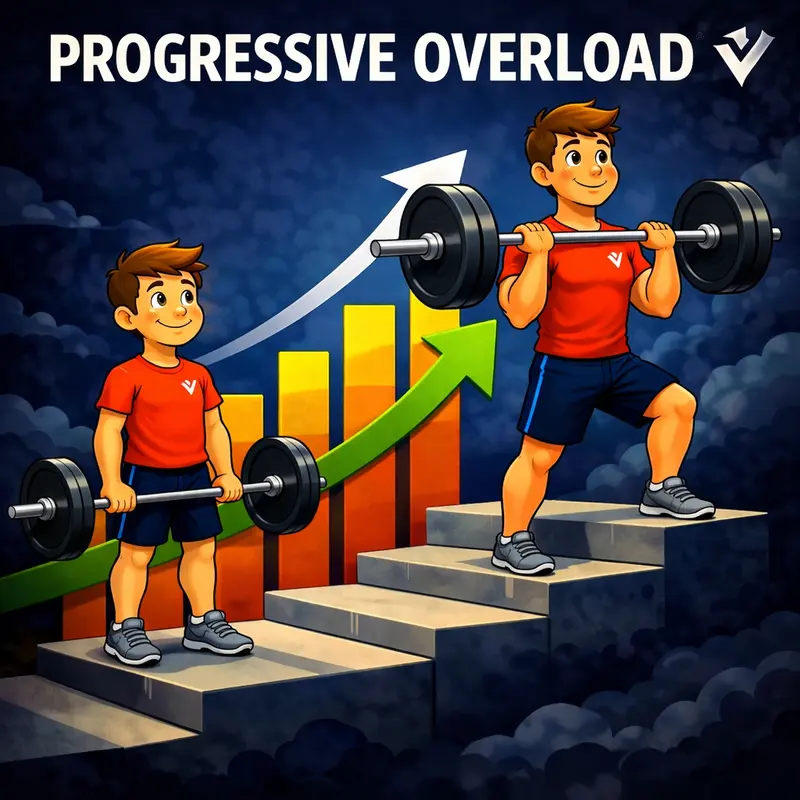
Progressive overload means that the training stimulus gradually increases over time. Your body adapts to the demands you repeatedly place on it. To continue growing or becoming stronger after that adaptation, training must remain sufficiently challenging. This does not mean adding weight to the bar every single workout.
What does progressive overload mean?
Progress in resistance training results from practice, recovery and adaptation. During the first weeks, strength often rises quickly because you become more skilled at the movement. Later, smaller and gradual increases in training stimulus are usually required. The recent ACSM position stand describes this as progressive resistance training: the demands should develop alongside you, although the exact method can differ by goal and individual (Currier et al., 2026).
Must you improve every workout?
No. Performance fluctuates because of sleep, stress, nutrition, recovery and exercises performed earlier in the session. You therefore do not need a record in every workout. Focus on the trend across several weeks. A session in which you repeat the same load and repetitions can still be productive.
Research in which participants progressed either load or repetitions found that both strategies can increase strength and muscle mass. There is therefore no single mandatory route to overload (Chaves et al., 2024).
Ways to apply overload
More repetitions
Gradually perform more technically sound repetitions with the same load within your planned range.
A little more load
Increase the load once you reach the top of your repetition range at the intended effort.
More quality sets
Add sets only when extra volume suits your goal and recovery. More is not automatically better.
A larger effective range of motion
Performing the same load under control through a larger suitable range of motion can make the exercise more demanding.
A technically better repetition is certainly progress, but it is not always additional overload by itself. Better technique often enables reliable increases in repetitions or load later. Higher training frequency is not automatically overload either: it only increases the stimulus when it produces suitable additional training work that you can recover from.
Double progression: practical example
Double progression is simple for many lifters: first choose a repetition range and increase repetitions within that range. Only then do you increase the load.
| Session | Load | Result | Next step |
|---|---|---|---|
| 1 | 80 kg | 8 / 8 / 7 | Same load |
| 2 | 80 kg | 9 / 8 / 8 | Same load |
| 3 | 80 kg | 10 / 10 / 10 | Small increase |
| 4 | 82,5 kg | 8 / 8 / 7 | Build up again |
This example uses 8–10 repetitions. The same method can be used with other ranges. Increase the load by the smallest practical step; large jumps can unnecessarily reduce technique quality and total training volume.
The role of reps in reserve (RIR)
RIR means reps in reserve: the number of technically sound repetitions you probably could still have performed at the end of a set. At 2 RIR, you estimate that two more repetitions were possible. At 0 RIR, no further complete repetition is possible.
RIR helps you compare repetitions honestly. Ten repetitions with five left in reserve create a different stimulus from ten repetitions with one left. For hypertrophy, not every set has to reach complete muscular failure; training close to failure can be sufficient and usually produces less fatigue (Grgic et al., 2022; Robinson et al., 2024).
When should you not increase the load?
- When the planned repetitions are only possible with clearly worse technique.
- When you shorten the range of motion merely to move the load.
- When several consecutive sessions decline because recovery is insufficient.
- When pain develops that changes your movement or increases during the set.
Tracking progress with the PowerVita App
Progressive overload is only practical when you know what you did previously. In the PowerVita App, you record loads, sets and repetitions for each exercise. This allows you to compare previous performances and see whether a genuine upward trend develops across multiple sessions.
Explore the PowerVita AppSummary
Progressive overload does not mean every workout must be heavier. It means the training stimulus develops with you over the longer term. For many lifters, double progression is the clearest method: first add technically sound repetitions within a range, then make a small load increase. Keep technique, range of motion, RIR and recovery as consistent as possible.
Scientific references
- Chaves, T. S., Scarpelli, M. C., Bergamasco, J. G. A., et al. (2024). Effects of resistance training overload progression protocols on strength and muscle mass. International Journal of Sports Medicine, 45(7), 504–510. https://doi.org/10.1055/a-2256-5857
- Currier, B. S., D’Souza, A. C., Fiatarone Singh, M. A., et al. (2026). American College of Sports Medicine position stand. Resistance training prescription for muscle function, hypertrophy, and physical performance in healthy adults: An overview of reviews. Medicine & Science in Sports & Exercise, 58(4), 851–872. https://doi.org/10.1249/MSS.0000000000003897
- Grgic, J., Schoenfeld, B. J., Orazem, J., & Sabol, F. (2022). Effects of resistance training performed to repetition failure or non-failure on muscular strength and hypertrophy: A systematic review and meta-analysis. Journal of Sport and Health Science, 11(2), 202–211. https://doi.org/10.1016/j.jshs.2021.01.007
- Kassiano, W., Santos-Melo, V., Manske, I., et al. (2026). Progressive overload affects the magnitude of muscle hypertrophy. Medicine & Science in Sports & Exercise, 58(7), 1556–1565. https://doi.org/10.1249/MSS.0000000000003968
- Lovegrove, S., Hughes, L. J., Mansfield, S. K., et al. (2022). Repetitions in reserve is a reliable tool for prescribing resistance training load. Journal of Strength and Conditioning Research, 36(10), 2696–2700. https://doi.org/10.1519/JSC.0000000000003952
- Robinson, Z. P., Pelland, J. C., Remmert, J. F., et al. (2024). Exploring the dose-response relationship between estimated resistance training proximity to failure, strength gain, and muscle hypertrophy: A series of meta-regressions. Sports Medicine, 54(9), 2209–2231. https://doi.org/10.1007/s40279-024-02069-2