Almost everyone knows that smoking is unhealthy. Yet people continue to smoke, young people still start using nicotine, and vaping and waterpipe use have become part of new social habits. This is not because the warnings are unknown, but because nicotine dependence, immediate reward, habit formation and social influence can feel stronger in the moment than health damage that may become visible much later (World Health Organization, 2026; Trimbos Institute, 2025).
This article therefore goes beyond the familiar message that smoking causes cancer and lung disease. It examines why people continue using nicotine, how cigarettes, vapes and waterpipes differ, and what smoking may mean for circulation, muscles, nerves, bones, joints, recovery, fitness and fat loss.
Contents
- Summary
- Why do people still smoke?
- Nicotine and relaxation
- The social smoking moment
- Why do young people start?
- Vaping
- Waterpipe
- Effects on the body
- Circulation and fitness
- Muscle and recovery
- Bones, tendons and joints
- Nerve symptoms
- Hormones
- Immune system
- Fat loss
- Can training offset it?
- Quitting
- PowerVita perspective
- References
Summary
- Tobacco harms nearly every organ and there is no safe exposure level to tobacco smoke (World Health Organization, 2026).
- Nicotine withdrawal can create tension that is temporarily relieved by the next dose, which may feel like relaxation (World Health Organization, 2026; Taylor et al., 2021).
- Dutch young people report nicotine, taste, social and mental-health reasons for continuing to smoke (Trimbos Institute, 2025).
- Vaping is probably less harmful than continued smoking when an adult smoker switches completely, but it is not safe (RIVM, 2026).
- Smoking is associated with lower exercise capacity, lower resistance to muscle fatigue and poorer muscle outcomes (Degens et al., 2024; Lin et al., 2024).
- Smoking is associated with poorer fracture healing and more complications (Xu et al., 2021).
Everyone knows the risks — why do people still smoke?
People rarely smoke because they believe it is healthy. Use persists because the reward is immediate — nicotine, a break, social connection or distraction — while cancer, COPD and cardiovascular disease may feel distant. Tobacco and nicotine products are also designed and marketed in ways that promote appeal and repeated use (World Health Organization, 2025, 2026).
Knowledge alone does not remove dependence, an automated routine or a smoking social environment. In the Dutch Youth Monitor, monthly smokers most often mentioned nicotine, taste, social reasons and mental-health reasons for continuing (Trimbos Institute, 2025).
↑ BackNicotine and the feeling of relaxation
Repeated nicotine use can produce craving, irritability, restlessness and concentration problems between doses. The next cigarette temporarily reduces these withdrawal symptoms, which can be experienced as stress relief (World Health Organization, 2026; Taylor et al., 2021).
A Cochrane review found that quitting did not worsen mental health on average and was associated with improvements in anxiety, depression, stress, positive mood and psychological quality of life (Taylor et al., 2021).
A cigarette may change the feeling for a moment, but it does not change the cause of workload, grief, uncertainty or exhaustion.↑ Back
Why do young people start and continue?
Curiosity, flavours, social influence, parties and peers all play a role. Pressure may be subtle: when a product is offered and everyone else uses it, use can begin to feel normal (Trimbos Institute, 2025).
Young people may underestimate dependence. In the Youth Monitor, fewer exclusive vapers felt addicted than exclusive smokers, despite nicotine in vapes being able to produce dependence (Trimbos Institute, 2025).
↑ BackVaping: less harmful does not mean safe
A vape heats liquid rather than burning tobacco. RIVM considers e-cigarettes probably less unhealthy than conventional cigarettes, but still unhealthy. The potential advantage mainly applies when an adult smoker switches completely; dual use preserves exposure to tobacco smoke (RIVM, 2026).
Vapour may contain nicotine and irritating or harmful substances. Flavours and design increase appeal, particularly among young people. A non-smoker gains no health benefit from starting (RIVM, 2026; World Health Organization, 2025).
Shisha and waterpipe
Passing smoke through water does not make it safe. Waterpipe smoke can contain nicotine, carbon monoxide, metals, particulate matter and carcinogenic compounds, and long sessions can produce a large inhaled smoke volume (World Health Organization, 2015).
Exposure varies by product, charcoal, duration and inhalation behaviour, so one session should not be equated with a fixed number of cigarettes. The robust conclusion is that waterpipe is not a harmless social alternative (World Health Organization, 2015).
↑ BackWhat does tobacco smoke do to the body?
Tobacco harms nearly every organ and increases the risk of cancer, cardiovascular disease, stroke, lung disease, reduced fertility, infections and premature death. Second-hand smoke is harmful and there is no safe exposure level (World Health Organization, 2026).
The damage is not caused by nicotine alone. Combustion creates a complex mixture of toxic and carcinogenic compounds; nicotine primarily drives dependence, while combustion products account for much of the disease burden (World Health Organization, 2026).
↑ BackCirculation, oxygen and fitness
Nicotine can raise heart rate and blood pressure and constrict vessels. Carbon monoxide binds to haemoglobin, reducing oxygen-carrying capacity, while chronic smoking may impair muscular mitochondrial function (Degens et al., 2024; Xu et al., 2021).
Smoking is associated with lower exercise capacity and lower local muscle fatigue resistance. The degree varies with exposure, health and training level (Degens et al., 2024).
↑ BackMuscle, resistance training and recovery
Chronic smoking is associated with lower muscle mass, lower strength and a higher risk of sarcopenia. Proposed pathways include impaired anabolic processes, inflammation, lower glucose uptake and poorer oxidative capacity (Lin et al., 2024).
This does not mean a smoker cannot build muscle, but smoking may create a less favourable environment for training quality, muscle maintenance and recovery (Degens et al., 2024; Lin et al., 2024).
You can still become stronger while smoking, but you are maintaining processes that can work against oxygen use, muscle function and recovery.↑ Back
Bones, tendons and joints
Smoking is associated with more fracture non-union and deep infection after fracture treatment; at least four weeks of preoperative cessation was associated with fewer postoperative wound infections (Xu et al., 2021).
Evidence differs between conditions. Smoking is an established risk factor for rheumatoid arthritis, particularly with greater lifetime exposure, while the relationship with ordinary osteoarthritis is less clear (Di Giuseppe et al., 2014).
↑ BackNerve pain and nerve damage
Nerve symptoms have many causes, so “smoking causes nerve pain” is too broad. In people with diabetes, smoking is associated with a higher risk of diabetic peripheral neuropathy, although causality and effect size remain under study (Bader et al., 2025).
New numbness, tingling, burning pain or weakness warrants medical assessment and should not automatically be attributed only to smoking.
↑ BackHormones and fertility
The popular claim that smoking automatically lowers testosterone in every man is incorrect. A meta-analysis found higher average measured total testosterone in male smokers, which does not make smoking hormonally healthy (Zhao et al., 2016).
Smoking remains harmful to fertility, vascular and sexual health, so its effects cannot be reduced to one hormone value (World Health Organization, 2026; Zhao et al., 2016).
↑ BackThe immune system is dysregulated
Smoking can both intensify damaging inflammatory responses and weaken protective responses. Components of innate and adaptive immunity are affected (Qiu et al., 2017).
For a trainee, this may indirectly contribute to illness, missed sessions and poorer continuity, although sleep, diet, stress and disease also matter (Qiu et al., 2017; World Health Organization, 2026).
↑ BackSmoking during fat loss
Nicotine may temporarily suppress appetite and quitting may be followed by some weight gain. A lower scale weight does not automatically mean better body composition or health; smoking is associated with poorer muscle outcomes and physical capacity (Degens et al., 2024; Lin et al., 2024).
A sound cut aims to reduce fat while preserving muscle, training quality and health. Smoking is therefore not a responsible weight-loss method.
↑ BackCan you train the damage away?
Exercise remains valuable for people who smoke, but it does not neutralise tobacco smoke or erase damage to lungs, vessels, DNA or tissue healing (World Health Organization, 2026).
The strongest combination is to keep moving while working to remove the exposure.↑ Back
Quitting is not only about character
Nicotine dependence includes withdrawal, routines and social triggers. Behavioural support improves long-term cessation rates, and effective options may include nicotine replacement, varenicline, cytisine and bupropion, depending on availability and medical suitability (Hartmann-Boyce et al., 2021; Livingstone-Banks et al., 2024).
A previous unsuccessful attempt does not mean quitting is impossible. Discuss appropriate support with a general practitioner or trained cessation professional.
Respect for the body you were given
To me, smoking is about more than a list of diseases. It is still defended as relaxation, sociability or a moment for yourself, yet I see nothing genuinely positive emerging from it.
I am grateful for the body and life I have been given. That body is not indestructible, so I want to treat it with care rather than knowingly neglect it.
You do not need a cigarette, vape or waterpipe to be social, take a break or talk to people. Smoking may temporarily numb a feeling, but it does not solve the cause of the tension.
“You only live once” therefore means something different to me: precisely because you have one life and one body, it is worth treating them with respect.
My opposition is directed at the product and its normalisation, not at the person struggling with dependence. That person deserves honesty and real support.
↑ BackContinue within Lifestyle
Scientific references
- Bader, S., et al. (2025). The association between smoking and diabetic neuropathy: a systematic review and meta-analysis. PubMed. Bron.
- Degens, H., et al. (2024). A modelling approach to disentangle the factors limiting muscle oxygenation in smokers. Experimental Physiology. PubMed.
- Di Giuseppe, D., Discacciati, A., Orsini, N., & Wolk, A. (2014). Cigarette smoking and risk of rheumatoid arthritis: a dose-response meta-analysis. Arthritis Research & Therapy, 16, R61. DOI.
- Hartmann-Boyce, J., et al. (2021). Behavioural interventions for smoking cessation: an overview and network meta-analysis. Cochrane Database of Systematic Reviews. PubMed.
- Lin, J., et al. (2024). Effects of cigarette smoking associated with sarcopenia in middle-aged and older adults. Scientific Reports. Full text.
- Livingstone-Banks, J., et al. (2024). Effects of interventions to combat tobacco addiction: Cochrane update. Addiction. PubMed.
- Qiu, F., Liang, C.-L., Liu, H., Zeng, Y.-Q., Hou, S., Huang, S., Lai, X., & Dai, Z. (2017). Impacts of cigarette smoking on immune responsiveness: Up and down or upside down? Oncotarget, 8, 268–284. DOI.
- RIVM. (2026). Wat is een e-sigaret? RIVM.
- Taylor, G. M. J., et al. (2021). Smoking cessation for improving mental health. Cochrane Database of Systematic Reviews. PubMed.
- Trimbos-instituut. (2025). Jongerenmonitor Tabaks- en Nicotineproducten. Rapport.
- World Health Organization. (2015). Waterpipe tobacco smoking and health. WHO.
- World Health Organization. (2025). Understanding the design features of tobacco, nicotine and related products and their possible effects. WHO.
- World Health Organization. (2026). Tobacco and nicotine. WHO.
- Xu, B., Anderson, D. B., Park, E.-S., Chen, L., & Lee, J. H. (2021). The influence of smoking and alcohol on bone healing: systematic review and meta-analysis of non-pathological fractures. eClinicalMedicine, 42, 101179. DOI.
- Zhao, J., et al. (2016). Cigarette smoking and testosterone in men and women: a systematic review and meta-analysis of observational studies. Preventive Medicine, 85, 1–10. PubMed.
Medical disclaimer
This article provides general education and does not diagnose disease. Discuss symptoms, medication and cessation treatment with a qualified healthcare professional.
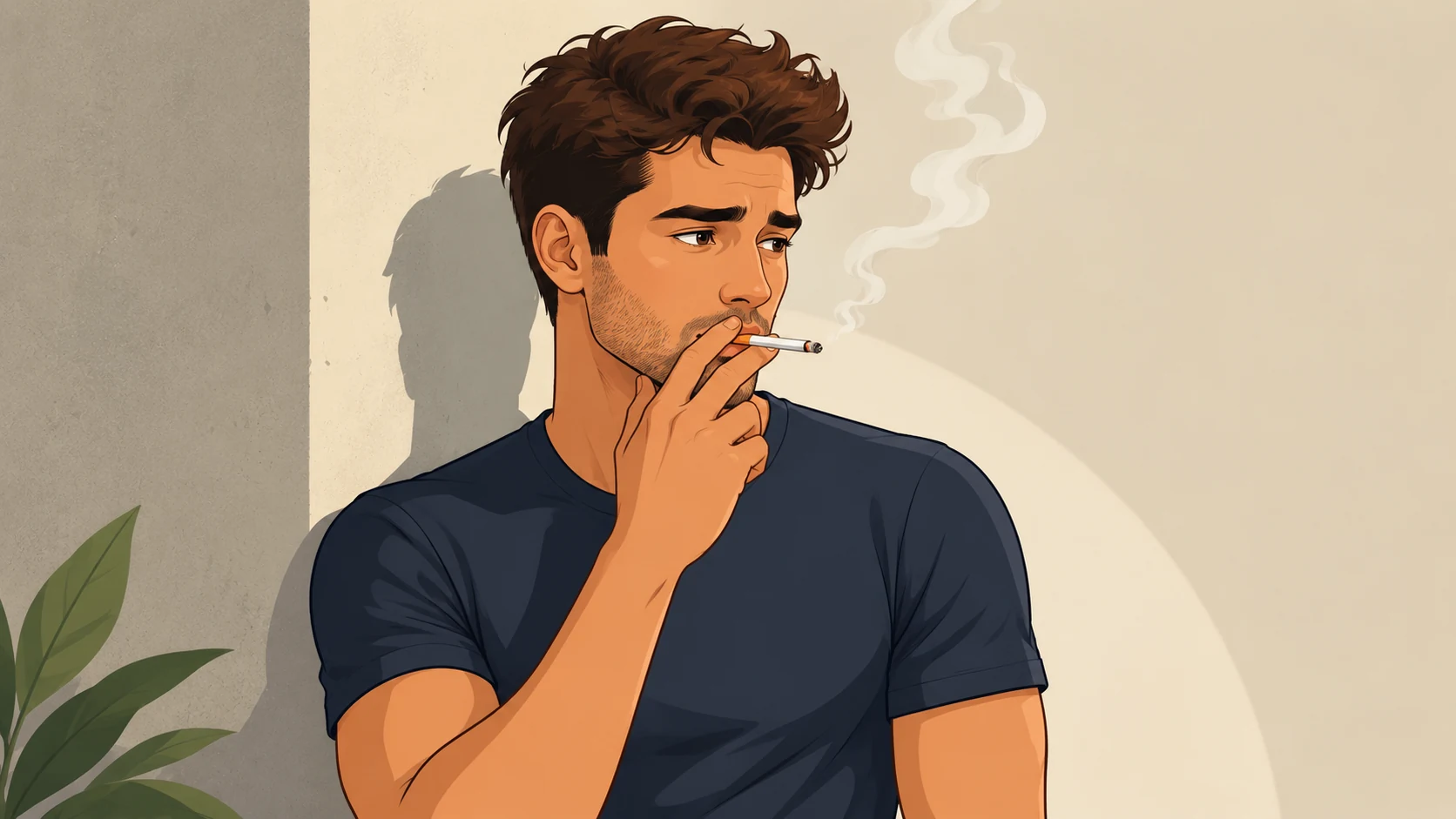
Is it the cigarette, or the moment?
Smoking becomes linked to coffee, driving, finishing a meal, work breaks and conversations. Repetition turns these contexts into triggers, while social context and habit formation reinforce the pharmacological effect of nicotine (Trimbos Institute, 2025; World Health Organization, 2026).
The positive part of a smoking break may be stopping work, going outside and talking. These functions can be retained without smoking: walk outside, move for five minutes or speak to colleagues without a cigarette.
↑ Back