Introduction
Fat loss is one of the most discussed topics in fitness and health. At the same time, it is also a topic surrounded by confusion. Online advice often sounds simple, but in practice it can give a distorted picture of how fat loss actually works.
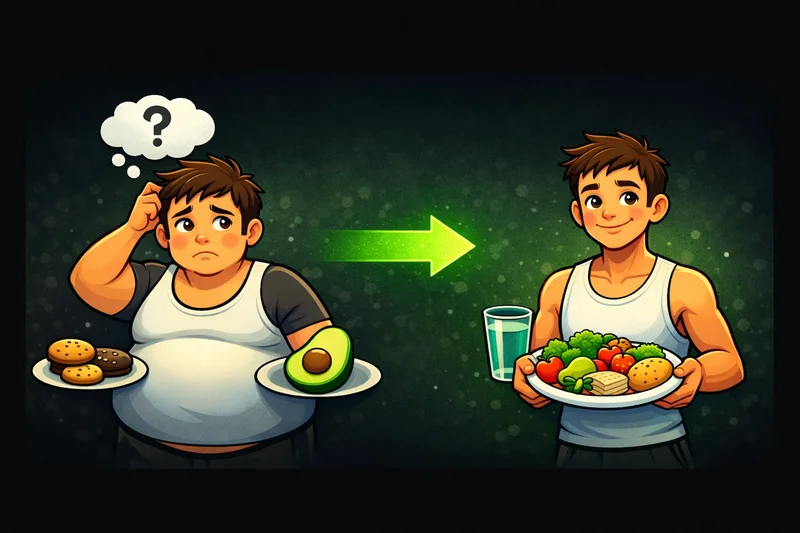
You often hear statements suggesting that it is better to eat a cookie than a banana or avocado simply because it contains fewer calories. Foods such as bananas are also sometimes unfairly avoided because of their energy content. This way of thinking may seem logical, but it is too limited. Fat loss is not only about calories, but also about satiety, behavior, food quality and the ability to sustain an approach over time.
The foundation: a calorie deficit
Weight loss occurs when there is a negative energy balance. This means the body uses more energy than it receives through food. This principle forms the basis of fat loss and has been widely studied in the scientific literature on weight regulation (Hall et al., 2012; Hill et al., 2012).
Without a calorie deficit, there will be no fat loss. Still, that is not the full story. Although a deficit is necessary, it does not fully determine how easy or difficult it is to maintain that deficit. This is where satiety, food quality and behavior come in.
Why counting calories is not enough
Two foods can contain a similar number of calories while having a completely different effect on the body. Foods rich in fiber, water or healthy fats often provide greater satiety and help control energy intake later in the day (Slavin, 2005; Rolls, 2009; Dreher & Davenport, 2013).
Highly processed foods, on the other hand, are often less filling and can negatively affect eating behavior. In a controlled study by Hall et al. (2019), participants consumed on average about 500 kilocalories more per day when they were given mostly ultra-processed foods, without consciously choosing to do so. This shows that calories do matter, but food quality and satiety also help determine how much someone ultimately eats.
The misconception around bananas, avocados and other nutritious foods
Foods such as bananas and avocados are sometimes unfairly portrayed as less suitable for weight loss simply because they contain more calories than some other foods. However, this is a misleading comparison. A banana provides carbohydrates, fiber, potassium and vitamin B6, while an avocado is rich in fiber, monounsaturated fats and several micronutrients (Dreher & Davenport, 2013).
Different fruits vary in composition, and that is exactly why variety matters. Not every piece of fruit is the same, and it does not need to be. Dietary variety is associated with better micronutrient intake and a healthier overall pattern (Ruel, 2003). Avoiding nutritious foods based on calories alone can therefore lead to a less balanced diet.
Satiety and total calorie intake
An important part of fat loss is not only what you eat at one specific moment, but also what happens afterward. Foods that do not satisfy well may cause you to eat more later in the day. Research on the satiety index shows that foods differ greatly in their ability to create a feeling of fullness (Holt et al., 1995).
When someone only looks at which option has fewer calories on paper, without considering satiety or nutritional value, that approach can backfire over time. A strategy that appears logical in the short term is not automatically the best strategy for sustainable results.
Tracking, weighing and gaining insight
Anyone who wants to lose fat seriously benefits from clear overview and insight. Research shows that self-monitoring, such as tracking food intake, is strongly associated with successful weight loss (Burke et al., 2011). Keeping track of calories and food choices helps reveal patterns, mistakes and unnoticed extras.
That is why it is wise to weigh your food, write it down and keep it in a logbook or nutrition app. By accurately tracking how much you eat, it becomes easier to control your energy intake and make targeted adjustments. Not to become obsessive, but to get an honest picture of what you are truly consuming.
Behavior, environment and consistency
Fat loss is not just a calculation, but also a behavioral process. What is available at home is eaten more often. What is visible and easy to reach is chosen more quickly. Research shows that the environment has a major influence on food choices and total energy intake (Wansink, 2010).
That is why it is wise to make deliberate choices already in the supermarket. When certain products are not present in the house, a large part of the temptation disappears as well. That makes it easier to stay consistent without constantly relying on willpower.
Cheat meals and relapse
In the early phase of a fat loss process, structure is often more important than flexibility. Habits still need to be built and are usually fragile at the start. Research on eating behavior shows that alternating between restriction and reward can contribute to loss of control and overeating, especially when impulse control is not yet strong (Herman & Polivy, 2008).
That is why it is often more effective to first build a stable pattern. Once the foundation is strong, it becomes easier to introduce more flexibility later without immediately falling back into old habits.
Sleep, recovery and fat loss
Sleep also plays an important role in weight regulation. Sleep deprivation affects hormones involved in hunger and satiety. Too little sleep can increase ghrelin and decrease leptin, which increases appetite and makes it harder to maintain a calorie deficit (Spiegel et al., 2004; Schmid et al., 2008).
People who consistently sleep better not only support recovery and energy levels, but often also improve their ability to make better food choices. Read more about this in the PowerVita Academy article on sleep and recovery.
Spot reduction does not exist
Another common misconception is that fat can be burned locally through specific exercises. Training the abdominal muscles, for example, does not directly cause fat loss around the waist. Research shows that fat loss occurs systemically and cannot be locally directed through targeted muscle training (Vispute et al., 2011).
Conclusion
Fat loss depends on a calorie deficit, but the way that deficit is created largely determines how realistic and sustainable the result will be. Anyone who only looks at isolated calorie numbers misses important factors such as satiety, food quality, behavior, sleep and environment.
Labeling a banana or avocado as worse than a cookie simply because it contains more calories is therefore far too simplistic. Sustainable fat loss requires overview, conscious choices and an approach focused not only on body weight, but also on health and long-term adherence.
Key takeaways
- A calorie deficit is necessary for fat loss, but it is not the only factor that matters.
- Food quality affects satiety, behavior and total energy intake.
- Nutritious foods such as bananas and avocados do not need to be avoided because of their calories.
- Weighing and tracking food intake helps create more control and insight.
- Sleep, environment and consistency play a major role in sustainable weight loss.
Want to learn more about nutrition and macros?
Discover more nutrition articlesReferences
Hall et al. (2012); Hill et al. (2012); Hall et al. (2019); Burke et al. (2011); Slavin (2005); Dreher & Davenport (2013); Mozaffarian et al. (2011); Ludwig et al. (2018); Holt et al. (1995); Herman & Polivy (2008); Wansink (2010); Spiegel et al. (2004); Schmid et al. (2008); Vispute et al. (2011); Ruel (2003); Rolls (2009)