You get stronger. You build muscle. You lift more weight. Your body changes — and that feels good. But what does that ultimately give you? In practice, there is often a strong focus on progress: more weight, more reps, more muscle mass. That is recognizable. At the same time, it becomes increasingly clear that physical progress alone is not everything. The moments that stay with you most are often not the kilos — but the experiences around them.
What is quality of life?
According to the World Health Organization (WHO), quality of life is “an individual's perception of their position in life in the context of culture, goals and expectations” (WHO, 1995).
So it is not only about physical health, but about the bigger picture: how someone feels, functions and experiences life.
Research shows that quality of life is shaped by physical, mental and social factors (Diener et al., 1999; Ryff & Singer, 1998).
Reality: getting stronger ≠ living better
In the fitness world, it is often assumed that more muscle mass automatically leads to a better life.
But that is not self-evident.
I notice that in practice as well. You can become stronger, but that does not automatically mean you experience more fulfillment.
At the same time, shared moments — training together and reaching a goal together — can have a much bigger impact.
Well-being depends not only on performance, but on how that performance is experienced (Seligman, 2011).
The 5 pillars of quality of life
Research divides quality of life into multiple dimensions:
- Physical health – energy, strength and functioning (Ware & Sherbourne, 1992)
- Mental health – emotions and satisfaction (Diener et al., 1999)
- Independence – being able to carry out daily activities (WHO, 1995)
- Social relationships – connection and support (Holt-Lunstad et al., 2010)
- Control and freedom – influence over one's own life (Cummins, 2000)
In training, the focus is often on the physical pillar, while it is actually the combination of these factors that determines how life is experienced.
Why fitness still matters
Strength training and exercise have proven benefits:
- Improved physical health and strength (Westcott, 2012)
- Reduction of depressive symptoms (Schuch et al., 2016)
- Improved quality of life (Bize et al., 2007)
- Better cognitive function (Hillman et al., 2008)
- Increased longevity (Warburton et al., 2006)
However, the value of training lies not only in these effects, but in how they contribute to daily life.
The social aspect of training
Training takes on a different meaning when it is shared.
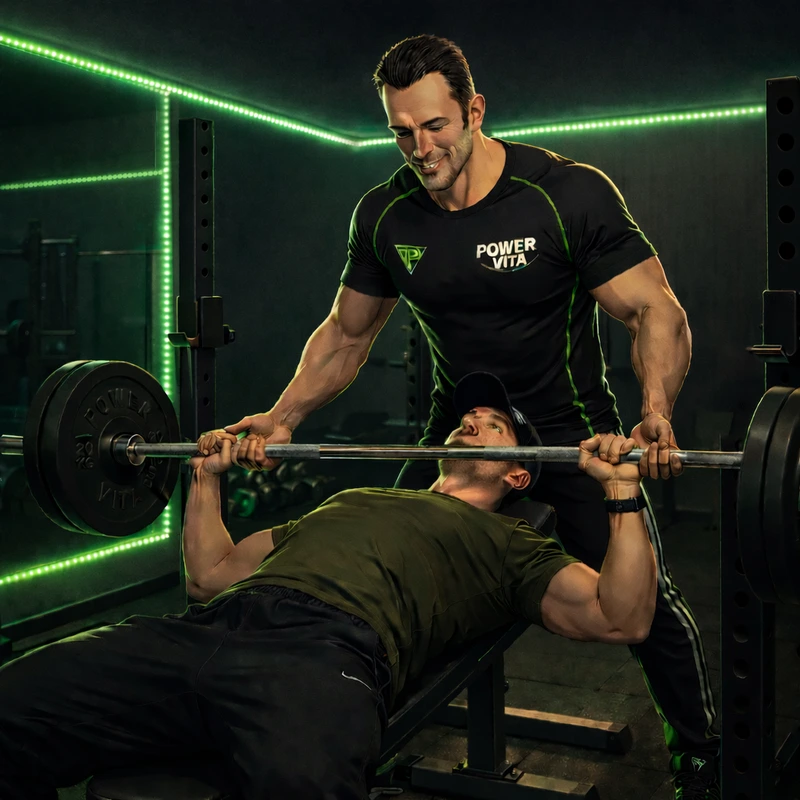
I notice that myself as well. I regularly train with my brother Samuel. What starts as a workout often becomes more than that: focus, fun and a moment of connection at the same time.
Some moments truly stay with you. For example, when Samuel reaches a goal, such as pressing 85 kilos on the bench and grinding out that final rep.
That moment of tension, persistence and finally succeeding creates a direct surge of energy. Not only for him, but also for me. Afterwards, something simple often follows: laughter, music, just enjoying the moment.
Those kinds of moments increase quality of life. Not only the achievement itself, but everything around it.
I have seen the same with my brother Ernesto. By training again and getting fitter, he also started to feel noticeably better.
More energy, feeling better in his own skin — that carries over into everything. And what is special is that seeing someone else change also gives me fulfillment.
That shows that training is not only individual.
Training together, reaching goals together and sharing those moments creates connection. And that connection plays a major role in quality of life (Holt-Lunstad et al., 2010).
Independence as a core element
One of the most important factors within quality of life is independence.
The ability to move independently, function independently and live life independently is strongly connected to well-being (Rejeski & Mihalko, 2001; Liu & Latham, 2009).
Training only gains real value when it helps preserve that independence.
The mental component
Quality of life is often linked to “feeling good,” but research shows that this consists of multiple layers.
Well-being consists of:
- Hedonic well-being – pleasure and happiness
- Eudaimonic well-being – meaning and purpose (Ryan & Deci, 2001)
Moments in which goals are reached together — such as a personal training milestone — combine both forms of well-being.
The right mindset
The question is not only how someone can become stronger or more muscular, but how training can contribute to a better life.
This can mean:
- More energy in daily life
- Fewer physical complaints
- Better mental balance
- Stronger social connection
- Long-term independence
Conclusion
Muscle mass is not the end goal. It is a tool.
The real goal is a life in which someone feels good, is connected to others and remains independent.
Training contributes to that — not only through physical progress, but especially through the moments that arise during the process.
The shared successes, the energy, the connection — that is where the real value lies.
References
WHO (1995); Diener et al. (1999); Ryff & Singer (1998); Seligman (2011); Ware & Sherbourne (1992); Holt-Lunstad et al. (2010); Cummins (2000); Westcott (2012); Schuch et al. (2016); Bize et al. (2007); Hillman et al. (2008); Warburton et al. (2006); Rejeski & Mihalko (2001); Liu & Latham (2009); Ryan & Deci (2001); Huppert (2009); Keyes (2002); Penedo & Dahn (2005); Netz et al. (2005); Ekkekakis et al. (2011).
Do you want help training smart, building resilience or getting stronger with a plan that fits your level and age? Visit the coaching page or get in touch with Mart.
Discover more mindset articles