Introduction
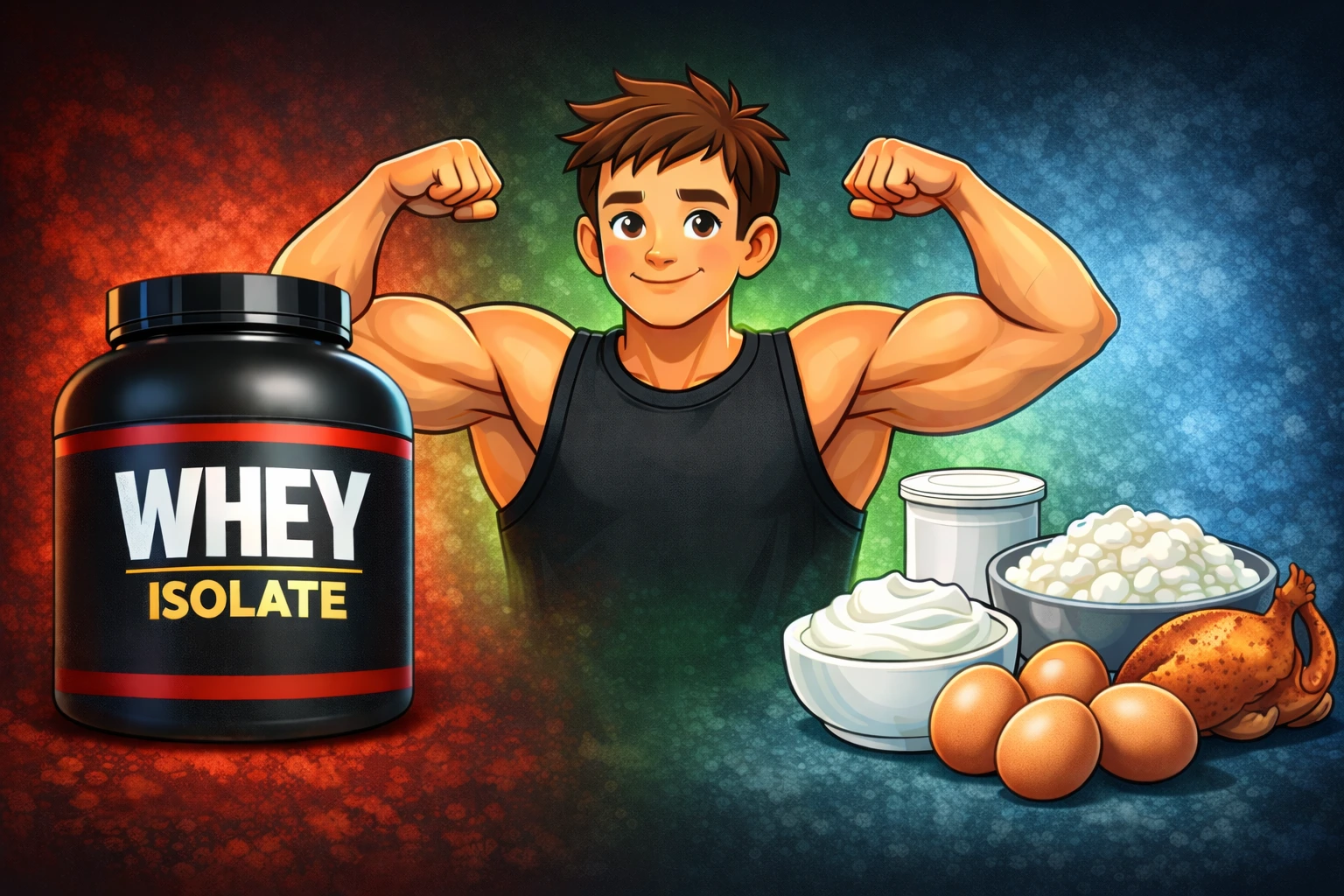
Whey protein has almost gained the status of a staple food in the fitness world. For many athletes, a shaker now feels just as normal as a training plan. Because of that, the idea has emerged that muscle growth without whey would be less optimal. That view is understandable, but too simplistic. The core question is not whether you use a shake, but whether you get enough protein and essential amino acids throughout the day to support recovery and muscle growth (Phillips & Van Loon, 2011; Jäger et al., 2017; Morton et al., 2018).
At its core, whey is simply a concentrated protein source. It can be useful, but that still does not make it a required condition for muscle growth. Anyone who gets enough protein from regular food can build muscle perfectly well without whey. Supplements are additions, not the foundation (Phillips & Van Loon, 2011; Jäger et al., 2017).
What really determines muscle growth?
Muscle growth mainly depends on progressive resistance training, sufficient energy intake, recovery and a high enough protein intake. The meta-analysis by Morton et al. (2018) showed that protein supplementation can support the training response, but that the effect becomes smaller once someone already eats enough protein. The ISSN position stand by Jäger et al. (2017) and the review by Phillips and Van Loon (2011) place a daily protein intake of about 1.4 to 2.0 grams per kilogram of bodyweight as sufficient for most athletes, while 1.6 to 2.2 grams per kilogram is often used in practice for muscle retention and muscle growth.
For someone weighing 90 kilos, 180 grams of protein per day is therefore not random. It fits neatly within the range that is often considered useful in the literature. The form of the protein matters less than the overall picture of training, energy intake, recovery and daily protein intake (Jäger et al., 2017; Morton et al., 2018; Nunes et al., 2022).
Why whey is popular
Whey is popular because it is practical. It contains a relatively high amount of protein per serving, is quick to prepare and is usually low in fat and carbohydrates. Whey is also rich in essential amino acids, including leucine, which plays an important role in stimulating muscle protein synthesis (Tang et al., 2009; Pennings et al., 2011; Jäger et al., 2017).
That explains why whey often performs well in acute studies, especially around training. But being practical and acutely effective still does not mean it is necessary as the foundation of a dietary pattern. It is mainly a tool that offers convenience when time, appetite or structure matter (Tang et al., 2009; Pennings et al., 2011).
Is whey better than regular food?
Not necessarily. Regular food often provides more than just protein, including satiety, taste, texture and micronutrients. Eggs provide not only protein, but also choline and other nutrients. Dairy products such as quark or skyr provide calcium and B vitamins. Chicken breast, fish, tofu and legumes also fit perfectly into a high-protein dietary pattern (Phillips & Van Loon, 2011; Melina et al., 2016).
From the perspective of satiety and nutritional quality, regular food is a more logical foundation for many people. Whey can be helpful on top of that, but it does not need to be the core of protein intake. Solid foods often make it easier to build a complete and sustainable pattern (Phillips & Van Loon, 2011; Jäger et al., 2017).
What about fast and slow proteins?
Whey and casein truly differ in absorption. In the study by Tang et al. (2009), whey stimulated muscle protein synthesis more strongly than casein and soy in the early phase after training. Pennings et al. (2011) also found that whey stimulated postprandial muscle building more strongly than casein in older men.
That is useful information, but it mainly says something about the acute moment. Over the course of an entire day, the main question remains whether someone gets enough total protein and essential amino acids. That is why quark is not inferior simply because it digests more slowly; it is just a different protein source with a different profile, which can actually be practical in the evening (Tang et al., 2009; Pennings et al., 2011; Kanda et al., 2016).
What does whey actually cost?
To compare price fairly, it is smarter to look not only at the price of a tub, but at the price per 25 grams of protein. At the moment, MyProtein Impact Whey Protein 5 kilos costs €114.99 and provides 21 grams of protein per 25 gram serving. That comes down to about 4,200 grams of protein in total and roughly €0.68 per 25 grams of protein. The current Impact Whey Isolate 500 grams costs €24.99 and provides 23 grams of protein per serving; converted, that is about €1.70 per 25 grams of protein.
By comparison, AH low-fat quark 500 grams costs €1.49 and provides 45 grams of protein per container, which comes down to about €0.83 per 25 grams of protein. AH Terra tofu family pack 500 grams costs €1.95 and provides 65 grams of protein in total, so about €0.75 per 25 grams of protein. AH free-range chicken breast 600 grams costs €8.99 and provides 150 grams of protein total, so about €1.50 per 25 grams of protein. Jumbo free-range eggs, 10 pieces, cost €4.49 and provide around 84 grams of protein in total, which is about €1.34 per 25 grams of protein.
Cost per 25 grams of protein
- MyProtein Impact Whey Protein 5 kg: about €0.68 per 25 grams of protein.
- MyProtein Impact Whey Isolate 500 g: about €1.70 per 25 grams of protein.
- AH low-fat quark 500 g: about €0.83 per 25 grams of protein.
- AH Terra tofu family pack 500 g: about €0.75 per 25 grams of protein.
- AH free-range chicken breast 600 g: about €1.50 per 25 grams of protein.
- Jumbo free-range eggs 10 pieces: about €1.34 per 25 grams of protein.
What does that price comparison show?
The conclusion is therefore not that whey is always more expensive than regular food. Regular whey concentrate can be quite competitive per gram of protein. But whey isolate is often relatively expensive, while inexpensive whole foods such as low-fat quark and tofu can be economically very strong. In addition, solid protein sources often provide more satiety and extra nutrients.
That is why the strongest position is not that whey is nonsense, but that whey is optional. For many people it is more logical to use regular food as the foundation and only use whey when convenience really adds something.
How do you replace whey with regular food?
If you want to reduce whey or remove it completely, first look at how much protein you currently get from shakes. If you use around 50 grams of protein from whey per day, you can often replace that with practical choices such as 500 grams of low-fat quark, several eggs spread throughout the day, a generous portion of chicken breast, or a combination of dairy, grains, soy and other protein sources.
For someone weighing around 90 kilos with a goal of about 180 grams of protein per day, a practical day could look like this: breakfast with oats or hot cereal and milk, later in the day eggs or a protein-rich lunch, then a warm meal with chicken breast, fish or tofu, plus a large serving of quark. By spreading protein across multiple meals, it becomes clear that whey is not a necessity but mainly a convenience product.
Are plant proteins different?
Plant proteins are on average not identical to animal proteins. Reviews by Van Vliet, Burd and Van Loon (2015), Berrazaga et al. (2019) and Mariotti and Gardner (2019) describe that plant proteins can have a lower content of essential amino acids and leucine on average and can sometimes be less digestible. Meta-analyses by Lim et al. (2021) show that animal protein may have a small average advantage for lean mass, while differences in strength are often limited.
That does not mean plant-based nutrition does not work. It mainly means that vegetarians and vegans have to plan more intelligently: enough total protein, enough variety and, where useful, strategic choices for strong sources such as soy, tofu, tempeh, legumes and grain combinations (Van Vliet et al., 2015; Berrazaga et al., 2019; Lim et al., 2021).
Can vegans get enough protein?
Yes. The Academy of Nutrition and Dietetics states that well-planned vegetarian and vegan dietary patterns can be healthy and nutritionally adequate. For athletes, however, this does mean that protein quality, total protein intake and smart source combinations deserve extra attention. Soy and soy products often play a strong role here, and studies on soy protein show that plant proteins can also support muscle protein synthesis, although the acute response is on average often somewhat lower than with whey (Melina et al., 2016; Yang et al., 2012; Kerksick et al., 2021).
In practice, it can be smart for vegans to aim a bit higher in total protein intake to partly compensate for differences in amino acid profile and utilization, especially when muscle growth is the goal (Van Vliet et al., 2015; Berrazaga et al., 2019).
What should vegans pay extra attention to?
The clearest micronutrient concern in a fully plant-based diet is vitamin B12. This vitamin is naturally found almost exclusively in animal products or in fortified foods and supplements. The claim that vegans mainly miss B1 and B2 by default is too simplistic. Riboflavin, or vitamin B2, can deserve attention, but B12 is much more clearly the main issue (NIH ODS Vitamin B12; NIH ODS Riboflavin).
In addition, iodine, iron, calcium, vitamin D and zinc may also deserve extra attention depending on how the diet is constructed. A plant-based diet can be nutritionally complete, but it usually requires a bit more planning than a mixed dietary pattern (Melina et al., 2016; NIH ODS Vitamin B12; NIH ODS Riboflavin).
Conclusion
Whey is not a must. It is a tool. Science shows that whey has acute advantages because of its rapid absorption and high leucine content, but that in the long run your total daily protein intake, training stimulus and recovery matter most (Tang et al., 2009; Pennings et al., 2011; Morton et al., 2018).
When it comes to price, whey isolate is often relatively expensive, regular whey can be economically competitive, and foods such as quark and tofu currently do at least as well or better per gram of protein. That is why the strongest conclusion is not that whey is nonsense, but that whey is optional. Build your foundation on real food, and only use whey when it truly adds convenience.
Key points
- Muscle growth mainly depends on training, recovery, energy intake and total daily protein intake.
- Whey is useful, but not necessary for muscle growth.
- Regular whey can be competitive per gram of protein, but whey isolate is often relatively expensive.
- Whole foods such as quark and tofu can be economically strong and provide more satiety.
- Plant proteins also work, but often require more planning and attention to micronutrients such as B12.
Related articles
Want to learn more about nutrition and macros?
Discover more nutrition articlesReferences
Phillips & Van Loon (2011); Jäger et al. (2017); Morton et al. (2018); Nunes et al. (2022); Tang et al. (2009); Pennings et al. (2011); Kanda et al. (2016); Van Vliet et al. (2015); Berrazaga et al. (2019); Mariotti & Gardner (2019); Lim et al. (2021); Melina et al. (2016); Yang et al. (2012); Kerksick et al. (2021); NIH Office of Dietary Supplements - Vitamin B12; NIH Office of Dietary Supplements - Riboflavin; current product pages from MyProtein, Albert Heijn and Jumbo.